COVID-19 infection Rates Surge

1 min read

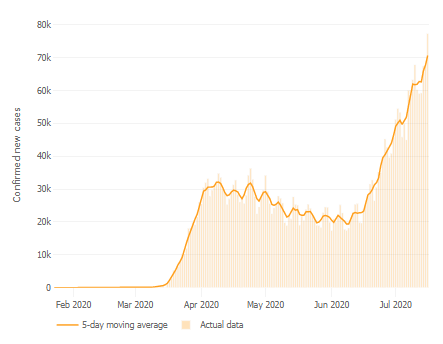
COVID-19 infection rates have fallen dramatically in most industrialized nations, but new cases in the U.S. and in developing countries have surged to record levels in the last few weeks. Despite the serious setbacks, lawmakers in the U.S. continue to grapple with how to most appropriately implement mask requirements to slow the spread of the virus. While U.S. manufacturing production and retail sales began to improve in May and June after a deep retrenchment in April, the rapid increase in daily infection rates has many states pulling back on economic reopening efforts.
Source: Johns Hopkins, https://coronavirus.jhu.edu/

Treasury Yields Continue to Fall

With the spike in new infections and deaths, uncertainty clouds most forecasts on the pace and timing of the economic recovery and Treasury yields have continued to fall as we move into the summer. The 1-year T-Bill yield is down to 0.14% as of today compared to 0.16% at the end of June and to 0.17% at the end of May. The 10-year Treasury yield shrank to 0.62% as of today compared to 0.66% at the end of June and 0.65% at the end of May.

Fed Funds Futures

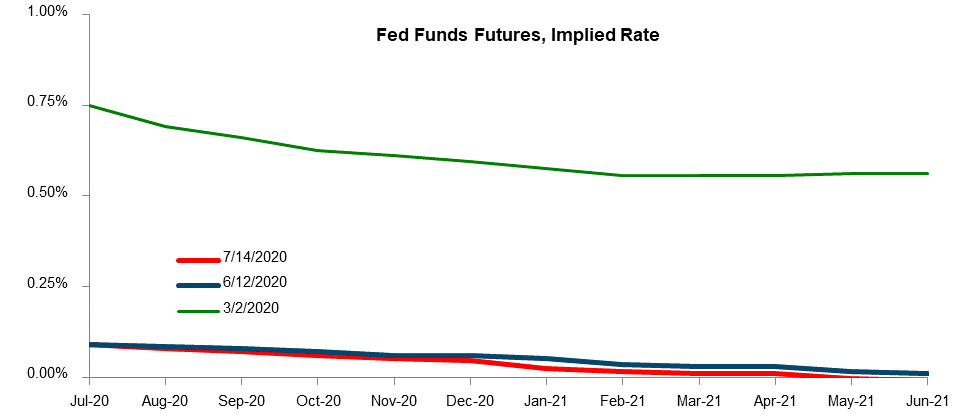
Futures contracts maintain a meaningful probability that overnight rates could further compress in the year ahead. Capital Advisors Group recommends that its clients move cash from overnight vehicles into direct purchases of term debt as liquidity requirements and cash use forecasts allow.
Source: Bloomberg

Please click here for disclosure information: Our research is for personal, non-commercial use only. You may not copy, distribute or modify content contained on this Website without prior written authorization from Capital Advisors Group. By viewing this Website and/or downloading its content, you agree to the Terms of Use & Privacy Policy.


Similar Posts

  • April Mid-Month Market Update

    4 min read4 min read March Labor Market Data Rebounds Labor market data showed signs of improvement in early April, following February’s weaker-than-expected report:  While the unemployment rate edged lower to 4.3% (4.256% unrounded), the improvement was driven in part by a decline in the labor force participation rate, which fell to its lowest level since 2021…

  • March Month-End Market Update

    5 min read5 min read Q1 2026 Recap Geopolitical tensions drove markets in Q1 2026, with the Iran conflict overshadowing much of the quarter. Early signs of escalation—highlighted by comments from Donald Trump in January—began pushing oil prices higher, though Treasury yields were initially driven by monetary policy expectations, reflecting markets anticipation for one to two rate cuts from the Federal…

  • March FOMC Update

    2 min read2 min read FOMC Maintains Target Range, Outlook is Uncertain As widely expected, the Federal Open Market Committee left the federal funds target range unchanged at 3.50%–3.75%. Key takeaways from the meeting are outlined below: Statement Summary of Economic Projections Powell’s Press Conference Market Reaction

  • March Mid-Month Market Update

    3 min read3 min read March Madness in Markets The conflict with Iran has now entered its third week and has triggered notable shifts across global markets. Oil prices have spiked, Treasury yields have moved higher, equities have declined, and market expectations for Fed rate cuts have been scaled back. Much of the market’s attention remains focused on the…

  • February Month-End Market Update

    6 min read6 min read Fed Tone Suggests Patience on Rate Cuts We have seen a noticeable shift in the Federal Reserve’s tone over the past several weeks, including comments from several of its more dovish members that reinforced expectations that the FOMC will remain on pause for the time being.  Importantly, the shift in tone from policymakers who had previously leaned dovish has delayed market expectations for additional rate…

  • February Mid-Month Market Update

    4 min read4 min read Labor Market: Mixed Signals, Strong Payroll Surprise Due to the second government shutdown, the monthly jobs report from the Bureau of Labor Statistics was delayed by several days. In the interim, a series of labor market releases pointed to potential softness in employment trends:  Collectively, these reports suggested mounting weakness in labor demand and raised concerns heading…