November Mid-Month Market Update
Hawkish Fed Rhetoric, Divided Policy Views
Recent comments from Fed officials have been hawkish, with some policymakers advocating a more aggressive approach to rate increases (see chart below). For example, Fed Governor Christopher Waller said a 50 basis point hike should be considered at the December FOMC meeting if the CPI report came in at 0.3% or higher, a threshold it ultimately reached just hours later. Dallas Fed President Lorie Logan has also supported at least two additional quarter-point increases, suggesting hikes may need to be implemented at a relatively rapid pace.
However, as we have seen over the past several months, not all Fed officials share this more aggressive stance. New York Fed President John Williams struck a more cautious tone, acknowledging that inflation remains too high but emphasizing that policymakers must also avoid unnecessarily harming the labor market. While the overall tone of recent Fed commentary has been hawkish, Waller’s call to consider a 50 basis point increase appears to be an outlier.
Fed funds futures are pricing in just an 8% probability of a 50 basis point increase, with expectations centered on a 25 basis point hike at the upcoming December meeting, followed by two additional increases in 2027 (see chart below).


Jobs Remain Strong, Inflation Stays Hot
November’s economic data releases are shaping up much like September’s, with a stronger-than-expected jobs report followed by a hotter-than-expected CPI reading. The combination highlights the ongoing challenge facing the Fed: a resilient labor market alongside persistent inflationary pressures.
- Labor Market: October nonfarm payrolls increased by 165,000, well above expectations of 70,000. In addition, August and September payrolls were revised upward by a combined 84,000. The unemployment rate declined to 4.1%, a solid reading considering the labor force participation rate also increased, which would typically put upward pressure on unemployment. Weekly jobless claims have also remained historically low, with the four-week moving average falling to 195,250, its lowest level since 1969.
- Inflation: Both headline and Core CPI exceeded expectations in October, rising 0.4% and 0.3%, respectively. Core CPI has now increased 0.3% for three consecutive months, putting its three-month annualized rate at 3.75%, the highest in more than two years. More concerning for the Fed is the broad-based nature of the price increases across both goods and services. Food prices rose 0.5%, the largest monthly increase since April, bringing year-over-year food inflation to 3%. Gasoline prices increased 1%, while airfares rose 0.4%, suggesting that higher energy costs continue to filter through to other areas of the economy.
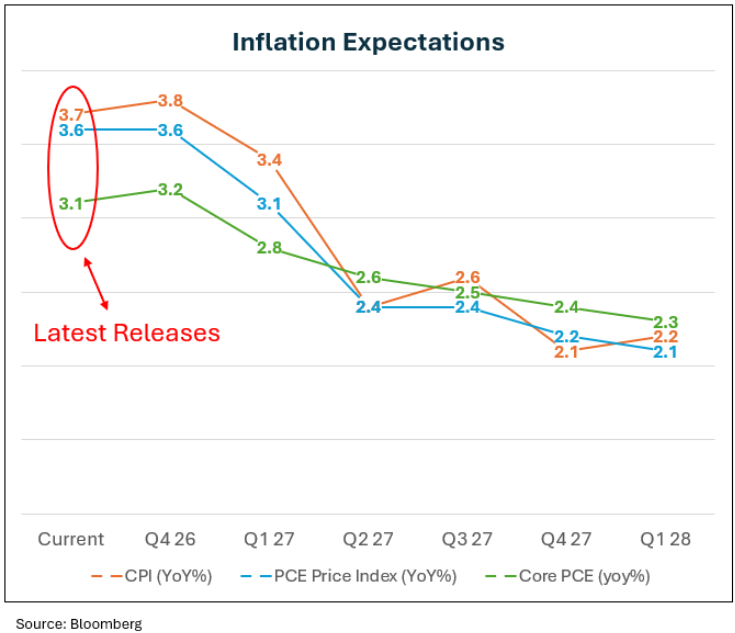
Despite the recent inflation readings, forecasts continue to point toward a gradual moderation in price pressures through the end of 2027. Headline PCE inflation is expected to decline from its current 3.6% reading to 2.2% by the fourth quarter of 2027, while Core PCE is projected to ease from 3.1% to 2.4%. Although the projected path is encouraging, the latest data reinforces the challenge facing the Fed as it balances persistent inflation against a still-resilient labor market.
Markets: Higher Yields, Mixed Equities, Strong Credit
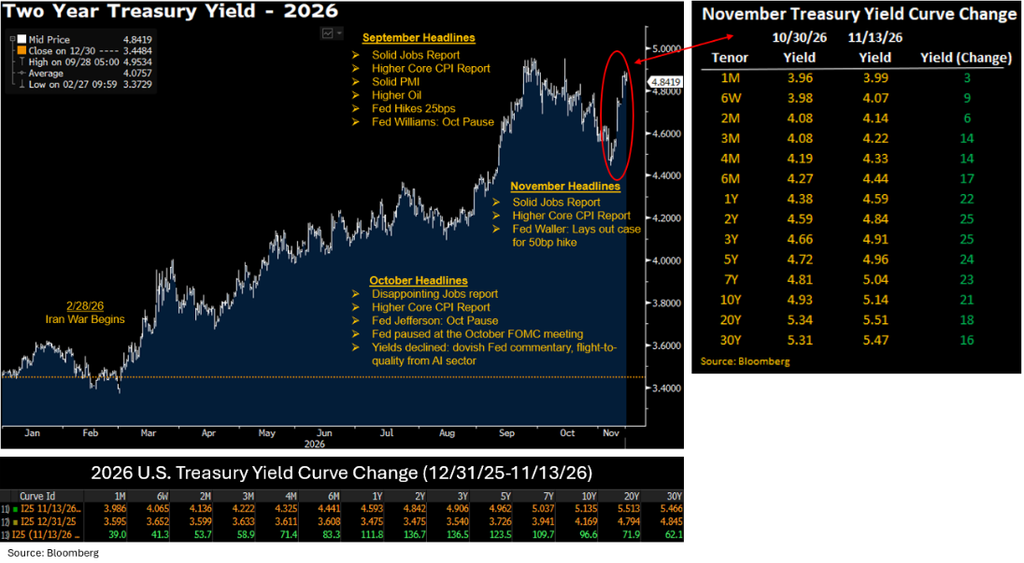
- Higher-than-expected inflation readings and increasingly hawkish Fed commentary have pushed Treasury yields higher across the curve so far in November. The 1-year and 2-year Treasury yields have risen 22 and 25 basis points, respectively, as markets continue to price in additional Fed rate increases.
- Equity markets have been mixed, reflecting the recent headlines and growing concerns surrounding the technology sector. The Nasdaq, with its heavier concentration in technology stocks, is down more than 1%, while the Dow Jones Industrial Average has gained more than 1%. The S&P 500 has been relatively unchanged, declining just 0.20% for the month.
- Credit markets have remained resilient despite the rise in Treasury yields. Investment-grade spreads in the 1–3-year Bloomberg Credit Index are unchanged, while the broader 1–30-year index has tightened 3 basis points month-to-date. High-yield spreads have also strengthened, tightening 25 basis points so far in November.
- Meanwhile, this week’s investment-grade corporate bond issuance is expected to push year-to-date new issuance above $2 trillion for the first time on record.
Please click here for disclosure information: Our research is for personal, non-commercial use only. You may not copy, distribute or modify content contained on this Website without prior written authorization from Capital Advisors Group. By viewing this Website and/or downloading its content, you agree to the Terms of Use & Privacy Policy.