October FOMC Update
Fed Holds, Markets Expect Hike in December
As expected, the Federal Reserve left the federal funds target range unchanged at 3.75%–4.00%.
The Committee upgraded its assessment of economic activity from “solid” to “strong,” while reiterating that “domestic spending has been resilient.” At the same time, it acknowledged that “inflation remains elevated,” underscoring the continued challenge facing policymakers.
Importantly, the statement included language supporting a more patient approach to future rate increases. The Committee noted that “the accumulation of more information will help the Committee determine the policy stance appropriate to ensure a timely return of inflation to the Committee’s 2 percent goal.” This language reinforces the view that policymakers want additional data before deciding on their next move, rather than committing to a predetermined path of consecutive rate hikes. (See FOMC statement changes below.)
Recent comments from two key Fed officials have been consistent with this message. Vice Chair Philip Jefferson said, “My colleagues and I will need to come to our own judgment, which may take more time,” while New York Fed President John Williams emphasized that “there is no need for urgency, and we have time to gather more information.”
The decision included two dissents, with Cleveland Fed President Beth Hammack and Fed Governor Lisa Cook favoring a rate increase. Cook’s dissent was particularly notable, as dissents by Fed governors are relatively uncommon. The split decision highlights the differing views within the Committee over whether inflation risks warrant further tightening now or whether policymakers should wait for additional data.

Warsh Press Conference
In his press conference, Fed Chair Kevin Warsh said that “economic activity is expanding at a strong pace” and labor market “conditions are quite positive,” highlighting strong growth in business and investment spending. However, inflation remains a key focus for the FOMC, having run above the Fed’s 2% objective for nearly six years. Warsh acknowledged the recent spike in oil prices, noting that “energy and related prices have moved higher again in recent weeks.” He emphasized that the Fed’s goal is to ensure these price increases “do not broaden out across the economy.”
Warsh stated that since the Fed’s September rate increase, policymakers have begun to see changes in financial and credit conditions for some businesses and households. Although overall financial conditions have tightened, he cautioned against characterizing them as restrictive, saying, “I’m unwilling and unable to call them tight.”
He also announced changes to the FOMC meeting schedule beginning in the fall of 2027. The Committee will continue to hold eight meetings annually, but one will focus exclusively on broad monetary policy strategy, with neither a federal funds rate vote nor a policy statement released. For 2028, Warsh expects two meetings to be dedicated to strategy discussions and six to monetary policy decisions.
During the Q&A, Warsh was asked why the Fed did not raise rates at this meeting despite limited progress toward its 2% inflation target. Although his response was not entirely direct, Warsh noted that both inflation compensation and inflation expectations have been moving in the right direction. He emphasized that incoming data will help determine the appropriate policy stance, adding that “the period right in front of us is information-rich.” His comments reinforce the Fed’s data-dependent approach and suggest policymakers want more information before committing to further rate increases.
He was also asked whether the statement’s new language about accumulating more information implied that the current federal funds rate was appropriate. He was noncommittal, leaving the Fed’s next move uncertain. His response suggests that another rate hike at the December meeting is not a foregone conclusion, although further tightening remains possible and the Fed Funds futures market after the close was pricing in over an 80% probability of a 25 basis point rate cut at the December FOMC meeting.
Market Reaction
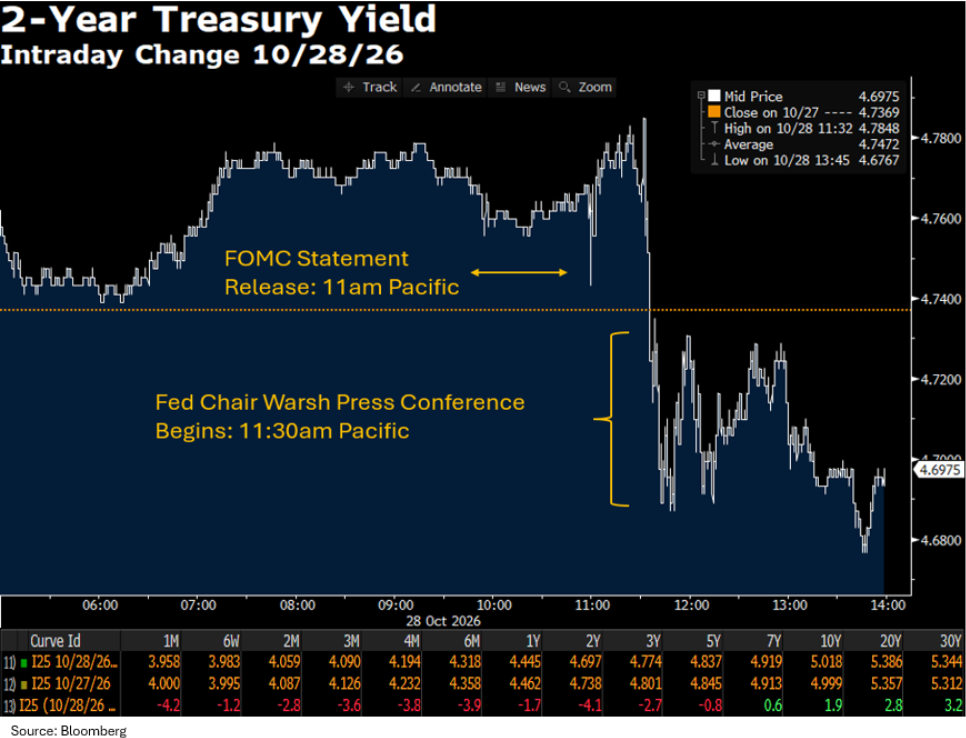
Prior to the FOMC meeting, the 2-year Treasury yield was up a few basis points on the day. Following the statement release, the yield rose approximately 4 basis points to 4.78% before reversing course and closing lower at 4.697%. Equity markets and credit spreads were little changed on the day, suggesting a relatively muted overall market reaction to the Fed’s announcement.
Please click here for disclosure information: Our research is for personal, non-commercial use only. You may not copy, distribute or modify content contained on this Website without prior written authorization from Capital Advisors Group. By viewing this Website and/or downloading its content, you agree to the Terms of Use & Privacy Policy.