

One Network. Billions in Exposure.
What the Walter Investigation Reveals About Private Credit and Insurance Risk.
Key Takeaways
- Affiliated investments matter: Delaware Life’s reported affiliated holdings reached $19.1 billion in June 2026, representing 39% of general-account invested assets.
- Diversification can be misleading: Multiple investments may ultimately depend on the same borrowers or affiliated businesses.
- Look beyond ratings: Investment structure, overlapping exposures, and who absorbs potential losses all matter in credit analysis.
- Watch for signs of stress: Repeated loan extensions, payment-in-kind interest, and limited pricing transparency may warrant closer scrutiny.
- Assess the insurer’s resilience: Capital, liquidity, governance, and refinancing capacity may help determine its ability to withstand credit losses.
The Walter Investigation: Delaware Life’s Affiliated Investments
An insurer can own hundreds of investments and still depend on a small circle of borrowers. That is what makes the investigation into Mark Walter’s insurers relevant beyond his businesses, raising questions about affiliated investments and insurance company credit risk.
Walter, best known as the owner of the Los Angeles Dodgers and the Lakers, co-founded Guggenheim Partners. His TWG Global group controls Group 1001, which includes Delaware Life and Clear Spring Life and Annuity. Guggenheim manages investments for the insurers.
The concern is that funds backing insurance obligations helped finance businesses connected to Walter, with those relationships inadequately disclosed.[1,3,11]
Delaware Life says it received a grand jury subpoena in February 2026 and faces a parallel SEC investigation. The insurer has acknowledged investment-classification errors and weaknesses in financial reporting controls. However, TWG denies fraud.[1,2]
Delaware Life’s affiliated investment exposure
The amounts are substantial.
- Year-end 2025: $18.3 billion in affiliated holdings, or 42% of general-account invested assets.
- June 2026: $19.1 billion in affiliated holdings, or 39% of general-account invested assets.
These figures apply to Delaware Life alone.[2]
Plans to reduce affiliated holdings
In its September update, Delaware Life described an agreement to exchange up to $6.5 billion in affiliated holdings for unaffiliated assets from TWG, subject to regulatory approval.
Further transactions aim to reduce affiliated holdings to:
- 20–25% of invested assets by year-end 2026.
- Below 10% by June 2027.
These are plans; their credit benefit depends on completion and the replacement assets.[2]
Follow the Repayment
Related-party lending is permitted, subject to disclosure and, in some cases, regulatory approval. But it raises a question: was each investment made on terms that served the insurer, or to meet another group business’s funding needs? Common ownership can also leave several loans exposed to the same businesses.[2]
Look beyond the borrower’s name
Delaware Life’s June filing shows why identifying the borrower’s name is only the starting point. It reported:
- $16.82 billion in private-credit investments whose returns depended predominantly on affiliates.
- Roughly $821 million in additional funding-agreement and trust-note arrangements with similar dependence.
These investments sit within the broader affiliated exposure and should not be added to the $19.1 billion total.[3]
Compare the exposure with the loss cushion
Direct investments in affiliates and other related parties, excluding subsidiaries, totaled about $1.03 billion. Capital and surplus were $4.03 billion.
That comparison shows the scale of the exposure relative to the insurer’s loss cushion. It does not mean the entire exposure will be lost.[3]
Follow the money through the structure
Imagine an insurer lending to Company A, which passes the money to Company B. If Company A needs B’s payments to repay the insurer, then B matters to the credit decision.
Ten vehicles financing the same business do not create ten independent sources of repayment.
Special-purpose vehicles (SPV) are routine financing tools. The problem arises when their structure obscures shared exposures. Existing accounting rules already require certain investments dependent on affiliates to be classified accordingly. This case concerns how those rules were applied, rather than a rulebook that only captures direct loans.[2]
Reporting failures versus fraudulent intent
The investigation has not established why this has happened. Potential explanations could include weak controls, attempts to secure favorable regulatory treatment, or deliberate concealment.
Delaware Life has acknowledged reporting failures, but fraudulent intent is a separate question. The company also says the reclassification did not change reported year-end 2024 or 2025 capital, surplus or earnings.[2,4]
Why Insurers Buy Private Credit
Life insurers often receive money years before paying benefits. That can make them suitable lenders to businesses needing patient capital, provided loan cash flows match expected payouts and the yield compensates for credit risk, expenses and limited liquidity.
Private credit is a long-standing part of the insurance investment model
Private lending has been part of this model for decades. Chicago Fed research puts U.S. life insurers’ private placements at:
- $849 billion in 2024, representing about 14% of general-account assets.
- $386 billion in 2014, representing about10% of general-account assets.
Private placements are one measure of this market, not a synonym for every private-credit exposure.[5]
Why insurer-asset manager relationships matter
Alternative asset managers have strengthened their ties to insurers:
- Apollo and Athene: Merged in 2022
- KKR and Global Atlantic: KKR acquired a majority stake in 2021 and completed its acquisition in 2024.
These relationships make investment oversight important. However, common ownership alone does not establish the problems alleged in the Walter case.[6]
How private-credit exposure can overlap
An insurer can accumulate exposure through several routes. For example, they may:
- Own equity in a credit fund.
- Lend to that fund.
- Buy securities backed by its loans.
Each position has different protections, yet all can depend on overlapping borrowers.[7]
Figure 1 Different investments can lead back to the same borrowers
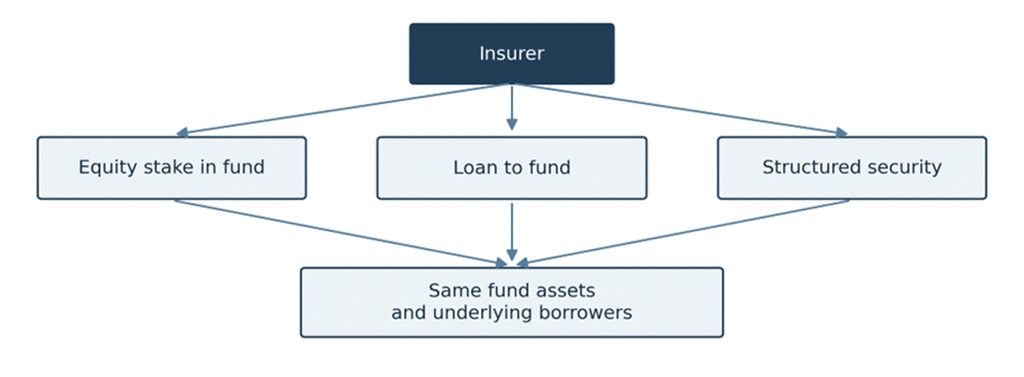
Illustrative only. Arrows show economic dependence, not payment priority or a specific Walter transaction.[7]
A Senior Rating Is Only Part of the Picture
When an insurer holds several positions in the same deal, how those positions are structured matters as much as who the borrower is. A senior debt claim can require substantially less regulatory capital than a direct equity investment. This can create an incentive to finance private assets through structures that issue highly rated debt alongside junior claims.
Who absorbs the first losses?
Lower capital requirements may be justified when independent investors absorb the first losses. But if the insurer owns both the senior debt and the junior position, it retains that junior risk elsewhere in its portfolio.
One transaction, reconstructed from statutory filings, is PDIF GCF CLO 2022-1, a roughly $438 million collateralized loan obligation (CLO) managed by Guggenheim Corporate Funding. Delaware Life reportedly owns the entire capital structure, from senior securities through the first-loss residual.
This is somewhat unusual, but we don’t yet know exactly why this occurred. It is economically quite different from Delaware Life buying a normal syndicated CLO in which independent investors establish market prices across the capital structure. If the insurer holds every tranche, the structure has not transferred credit risk to outside investors.[8]
What this means for regulatory capital
This arrangement does not, by itself, establish inadequate capital treatment. The answer depends on capital charges across all retained positions.
A senior rating also does not measure the insurer’s whole exposure. A guarantee provides limited diversification if the guarantor would weaken alongside the assets it supports.
Why valuation matters
Thin trading and infrequent pricing can make credit deterioration harder to observe. Creditors need evidence of borrower cash flows and potential recoveries, alongside reported valuations and credit ratings.
How Stress Could Spread
Insurers need not lend to one another to suffer related losses. Holdings backed by common borrowers can deteriorate together, although seniority and collateral affect each insurer’s loss.
Early warning signs of credit stress
Two potential warning signs are repeated maturity extensions and a shift from cash interest to payment-in-kind (PIK) interest, which adds to principal.
These changes can help a viable borrower recover, but they can also postpone recognition of a debt burden it cannot support. PIK triggered by cash shortages may warrant closer scrutiny than PIK agreed to at origination.
How credit losses can create a feedback loop
Credit stress can spread through several channels:
- Capital erosion: Recognized credit losses may reduce capital.
- Higher capital requirements: Downgrades may increase required capital.
- Tighter lending: Some insurers could respond by reducing new lending, making refinancing harder for borrowers.
This feedback loop is possible, not inevitable. Its severity depends on capital buffers, asset quality, and access to cash.
Why liquidity and refinancing matter
Long-term liabilities can give insurers time to respond, but liquidity needs vary by product. Surrenders, collateral calls, and wholesale funding maturities can create cash needs.
A short loan maturity provides little comfort if the borrower can repay only by borrowing again.
Lessons from the 2007 funding-agreement market
The 2007 experience offers a relevant comparison, with an important distinction. Federal Reserve research documents run on extendible funding-agreement-backed notes when investors stopped extending them.
Fixed-maturity FABNs do not give holders that same extension decision. Instead. their refinancing risk arises as scheduled maturities approach.[9]
What FABN Investors Should Examine
A funding-agreement-backed note (FABN) is typically issued by a special-purpose entity and backed by an insurer’s funding agreement. In general-account arrangements, repayment ultimately depends on the issuing insurer’s assets and claims-paying capacity.
Claim priority should be checked against the program documents and applicable state law. A noteholder’s claim on the issuer should not be confused with a direct insurance policy.[9,10]
Focus on the insurer behind the notes
The Walter case alone is insufficient to change a credit view on every large insurer. Equally, size and a high rating do not settle the issue.
Investors should consider the financial strength of the specific operating company supporting the notes.
Table 1 Questions for the insurer behind a FABN
| Area | Credit question |
| Concentration | Which investments share borrowers, and how large is the combined exposure relative to capital? |
| Governance | Who approves and values affiliated investments, and how independent is the review? |
| Capital | Can the insurer absorb losses and downgrades across all retained positions? |
| Liquidity | Can cash and liquid assets cover maturities, surrenders, collateral calls and commitments under stress? |
| Reinsurance | What risk was transferred, what collateral supports it, and could obligations return? |
The key is to understand how the money flows through the structure. A long list of securities can still conceal a concentrated portfolio.
For insurance creditors, the decisive questions may include who must repay, what happens if they cannot, and how much loss the insurer can absorb.
Sources
[1] Margot Patrick and Joe Wallace, The Wall Street Journal, August 29, 2026. Reporting on the investigation, short-term lending and TWG’s response. Article
[2] Delaware Life, September 11, 2026. Affiliated investment totals, reporting errors and proposed asset exchanges. Company statement. Company update
[3] Delaware Life Insurance Company, quarterly statement at June 30, 2026. Capital and surplus on printed page 4; related-party investments and management arrangements in Note 10, printed pages 7.11–7.12. Statutory filing
[4] Brian Peters, Perspective on Risk, August 21, 2026. Analyst commentary on possible explanations for the reporting failures. Analysis
[5] Ralf Meisenzahl, Jackson Overpeck and Andy Polacek, Life Insurers’ Private Credit Investments and Annuity Market Share Capture, Chicago Fed Working Paper 2025-09, revised April 2026. Private-placement holdings and historical comparison. Working paper
[6] Company announcements confirming the Apollo–Athene merger in 2022 and KKR’s completed purchase of Global Atlantic in 2024 following its 2021 majority investment. Apollo | KKR
[7] Federal Reserve, Life Insurers’ Role in the Intermediation Chain of Public and Private Credit to Risky Firms, March 21, 2025. Layered credit exposures and investment structures. FEDS Notes
[8] Nick Nemeth, The Cash Machine, Mispriced Assets, July 26, 2026. The PDIF GCF CLO example is attributed to his analysis of filings. Analyst article
[9] Federal Reserve, Funding Agreement-Backed Securities in the Enhanced Financial Accounts, August 5, 2016. Issuance structure and the 2007 run on extendible notes. FEDS Notes
[10] MetLife, How MetLife Funding Agreements Work; Massachusetts General Laws, Chapter 175, Section 132I. General-account backing and an example of state-specific priority provisions. MetLife | Massachusetts statute
[11] TWG Global insurance portfolio and Group 1001 company overview. Corporate relationships. TWG Global | Group 1001
Please click here for disclosure information: Our research is for personal, non-commercial use only. You may not copy, distribute or modify content contained on this Website without prior written authorization from Capital Advisors Group. By viewing this Website and/or downloading its content, you agree to the Terms of Use & Privacy Policy.