
To Hike or Not to Hike: Is the Fed About to Change Course?
Key Takeaways
- Inflation risk has re-emerged, driven by supply shocks and higher energy prices, complicating the Fed’s path toward rate cuts.
- Long-term inflation expectations remain above target, keeping price stability central to policy decisions.
- Markets have repriced the outlook, shifting from expected rate cuts to potential rate hikes.
- Economic conditions are stable but mixed, giving the Fed room to prioritize inflation overgrowth in the near term.
- Laddered cash portfolios may help manage uncertainty, balancing liquidity, reinvestment flexibility, and yield exposure across the curve.
Shifting Expectations: How the Middle East Conflict Altered the Fed’s Rate Path
The conflict in the Middle East has thrown a wrench into the Federal Reserve’s cutting cycle.
Prior to the initial attacks on Iran in March, the case for cutting rates in 2026 was strong:
- Measures of Personal Consumption Expenditures (PCE) inflation—while still above the Fed’s 2% target—were fairly stable and expected to improve as figures lapped the “one-time” impacts from tariffs.
- Measures of nonfarm payroll growth and unemployment had stabilized but remained tepid.
- Q4 GDP figures pointed to slowing economic momentum.
Then, the unprecedented closure of the Strait of Hormuz created, as the International Energy Agency (IEA) put it, “the largest supply disruption in the history of the global oil market.”[1] Brent crude prices rose as high as $118 per barrel—a 64% increase in just one month.
The resulting surge in energy prices quickly reignited inflation concerns:
- Headline PCE increased sharply from 2.8% in February to 4.1% in May.
- While core PCE excludes the direct impact of energy prices, rising input costs nonetheless pushed core inflation 40 bps higher over the same period.
Figure 1: Price of Brent Crude, $/bbl
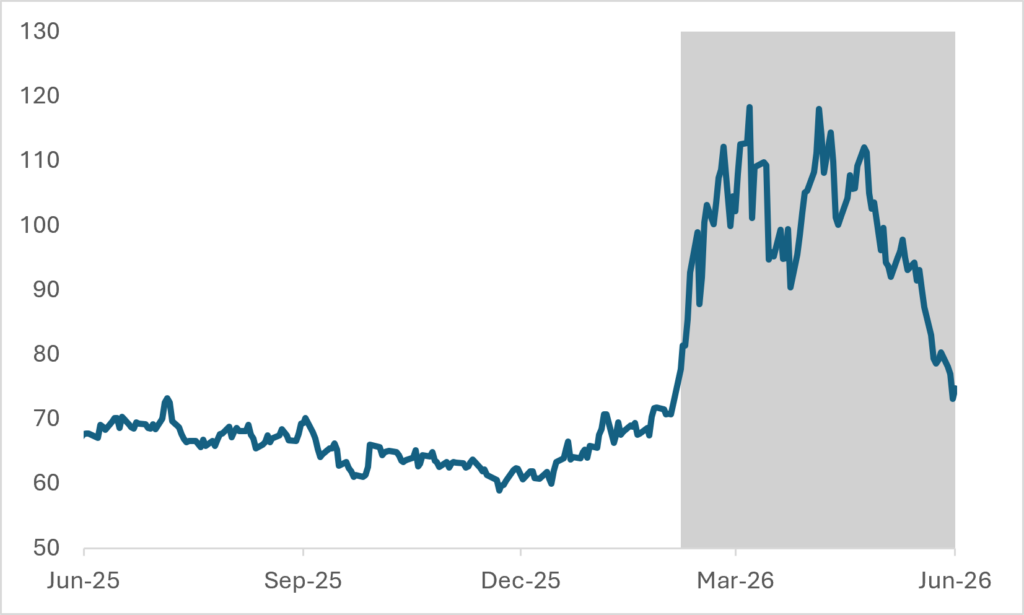
Shaded area indicates the period of Middle East Conflict
Source: Bloomberg
As the conflict persisted, market expectations for inflation and interest rates shifted. Measures of breakeven inflation moved notably higher, while fed funds futures increasingly priced in the probability that the Fed’s next move could be a rate hike rather than a cut.
The shift in market expectations was rapid:
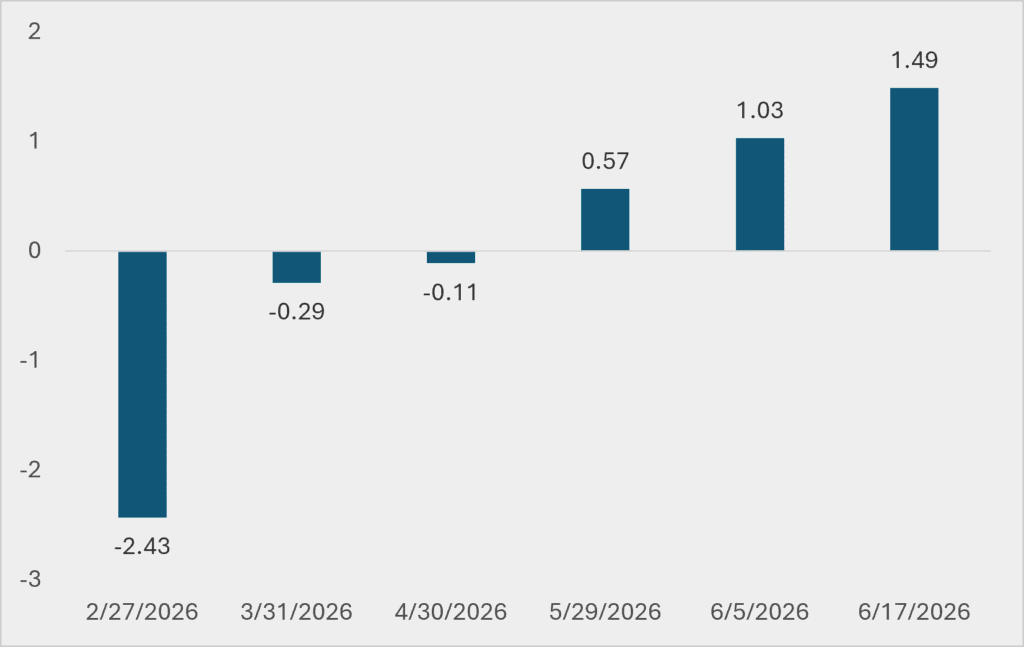
- At the end of February, markets were fully pricing in two Fed cuts by the end of 2026.
- By the end of March, markets had virtually eliminated the probability of additional rate cuts this year.
- Following the Federal Open Market Committee’s (FOMC) latest Summary of Economic Projections, published on June 17, markets fully priced in a rate hike by the end of 2026.
Figure 2: Number of Hikes (Cuts) Forecasted by December 2026, per Fed Funds Futures
Source: Bloomberg
Despite the normalization of oil prices and a decrease in longer-term breakeven inflation expectations, markets have continued to price in the probability that the fed funds rate will move higher, not lower.
Even as peace talks suggested the conflict was nearing its end, the June Summary of Economic Projections (SEP) reinforced the Fed’s inflation concerns:
- Fed officials projected both headline and core PCE inflation to end 2026 above 3%—substantially above their 2% inflation target.
- Nominal Treasury yields and fed funds futures rates rose following the FOMC’s statement that “the Committee will deliver price stability.”
- The language represented a firmer commitment than the previously used phrase “strongly committed.”
That statement was further reinforced by Fed Chairman Kevin Warsh, who reiterated the Committee’s focus on restoring price stability during his first press conference. Coupled with the Fed’s classification of the labor market as stable, the messaging suggests a greater willingness to tolerate slower economic growth or labor market weakness in pursuit of lower inflation.
As a result, the Fed under Chairman Warsh appears increasingly hawkish, placing inflation front-and-center within its dual mandate.
Figure 3: 2-Year Treasury Yields (%)
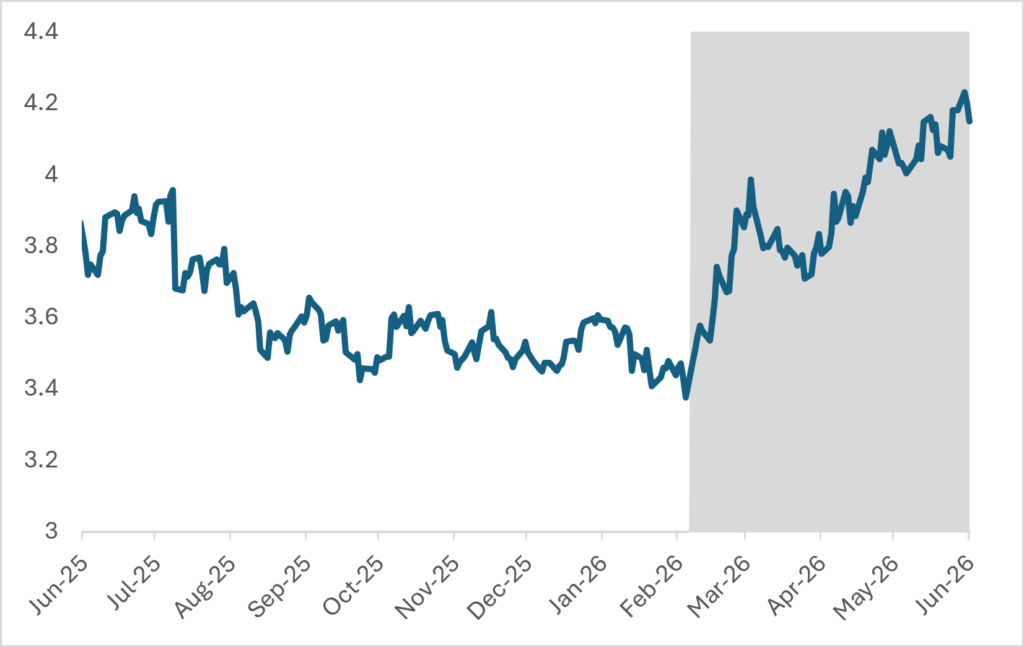
Shaded area indicates the period of Middle East Conflict
Source: Bloomberg
The Nuance of Hiking Rates: Why the Fed’s Decision is Not Straightforward
While markets and the June Summary of Economic Projections (SEP) are forecasting a higher fed funds rate, a rate hike is not a foregone conclusion.
Historically, central banks have been hesitant to raise interest rates in the face of supply shocks given:
- Negative implications for growth and employment
- Lagged effects of monetary policy
- Inherent volatility of price shocks
In other words, raising rates risks exacerbating an already challenging situation, particularly when demand-side growth is weak. This helps explain why the Fed did not raise rates in 2025 following the increase in tariff rates, despite a reacceleration in inflation.
Why, then, would the Federal Reserve consider hiking interest rates now?
The answer likely lies in the Fed’s dual mandate: achieving long-run inflation averaging 2% and maximum employment, which in the current environment is generally associated with unemployment ~4%.
When these two goals come into conflict, the Federal Reserve typically prioritizes the side of the mandate that is furthest from its target. Recent policy decisions demonstrate this balancing act:
- The FOMC left rates unchanged during the first half of 2025, primarily in response to tariff-related inflation uncertainty.
- In the second half of 2025, the Fed lowered the fed funds rate by 75 bps following signs of labor market weakness, despite a modest acceleration in inflation.
The Key Variable: Why Long-Term Inflation Expectations Remain the Fed’s Focus
Historically, the Fed has been willing to look past supply-driven price shocks when it believes the resulting inflation will be short-lived and longer-term inflation expectations remain well anchored.
However, the longer inflation remains above target, the greater the risk that longer-term expectations may drift away from the 2% target.
Recent market-based measures suggest this risk remains a concern:
- Both the 10-year breakeven inflation rate and the 5-year, 5-year forward breakeven inflation rate have picked up since March.
- Both measures have remained above 2% since 2021, indicating that long-term inflation expectations have stayed elevated for more than five years.
- The 10-year breakeven inflation rate rose from 2.26% on February 27 to as high as 2.52% on May 4, its highest level since March 2023.
- While the 5-year, 5-year forward breakeven inflation rate has been more stable, it too has picked up in recent months.
Figure 4: Breakeven Inflation Rates

Sources: Bloomberg, Federal Reserve
Persistently above-target core inflation presents an additional challenge. Not only does it increase the risk of de-anchoring inflation expectations, but it may also suggest that current interest rates are not sufficiently restrictive to bring inflation back toward the target. As a result, the trajectory of core inflation remains a meaningful gauge of Fed policy effectiveness.
Do Economic Conditions Support a Fed Rate Hike? The Data Says This.
Since the last round of rate cuts, the Fed’s policy calculus has shifted back toward the inflation side of its dual mandate. Several indicators suggest the economy may be resilient enough to withstand tighter monetary policy:
- The labor market has stabilized. Unemployment has remained low at 4.3% since March, while nonfarm payrolls growth has—on a 3-month rolling average—met or exceeded the Congressional Budget Office’s (CBO’s) estimate of breakeven job growth. (Figure 5)
- Underlying economic activity remains resilient. Real final sales to private domestic purchasers[2], which the Fed considers an often-better signal of underlying economic momentum than real GDP, have remained relatively stable and accelerated in Q1 (Figure 6).
Nonetheless, there are still signs of economic weakness:
- Real GDP growth has decelerated since 3Q25
- Personal consumption growth has moderated
- The housing market continues to soften, contributing to YoY disinflation
These crosscurrents make the decision to hike interest rates less straightforward than it was in 2022.
Figure 5: 3-Month Average Nonfarm Payroll Growth

Source: BLS
Figure 6: Measures of Economic Output, %QoQ SAAR

Source: BEA
While economists may debate the overall health of the economy, key measures of economic activity suggest conditions are, at the very least, stable.
Bottom Line: What It Would Take for the Fed to Raise Interest Rates
The bar for the Fed to raise interest rates during a supply shock is high, given the potential risks to the economy. However, as oil flows through the Strait of Hormuz normalize and supply-side pressures subside, the Fed may be more likely to raise rates if all of the following criteria are met:
- Long-term inflation expectations risk becoming untethered from the Fed’s 2% target
- Verdict: Not yet met. While inflation expectations have moved higher, longer-term measures remain anchored.
- Core inflation is expected to remain persistently above 2%, with recent shocks offsetting the favorable base effects from tariffs
- Verdict: Met. Core inflation has persisted above 2% for over five years and has shown signs of moving higher.
- Economic activity remains resilient, including both GDP growth and labor market readings
- Verdict: Met. Recent economic data has generally come in stronger than expected, while labor market conditions have remained stable.
The last point is particularly noteworthy, as the Fed may be reluctant to raise rates if policymakers believe doing so would push the economy into recession. However, as long as economic growth and labor market conditions remain stable, the Fed may have greater flexibility to focus on inflation risks.
What Should Cash Managers Do in an Uncertain Interest Rate Environment?
Despite the possibility of higher interest rates, cash investors may wish to consider selectively extending maturities.
A laddered portfolio may offer several potential benefits to help manage uncertainty:
- Liquidity. Staggering maturities across the curve may provide natural liquidity as securities mature.
- Maintaining reinvestment flexibility. If the Fed raises interest rates sooner than anticipated, maturing securities may be redeployed at higher yields.
- Establishing exposure across the yield curve. Selectively extending maturities may help investors to maintain exposure to current longer-term yields while reducing concentration at a single point on the curve.
Diversifying maturity exposure. The structure of a laddered portfolio approach may help cash investors avoid putting all their eggs in one basket. On the flipside, as previously mentioned, a rate hike remains possible—but not definitive. A shift toward more favorable geopolitical outcomes or a weakening economy could once again push yields lower, as demonstrated by the market reaction following the interim peace talks. In this uncertain environment, a laddered portfolio may help provide a natural hedge by preserving reinvestment flexibility if rates move higher by allowing investors to lock in some longer-term
[1] https://www.iea.org/reports/sheltering-from-oil-shocks
[2] Final sales to private domestic purchasers are the sum of consumer spending and gross private fixed investment. This figure strips out net exports, changes in private inventories, and government spending from real GDP.
Please click here for disclosure information: Our research is for personal, non-commercial use only. You may not copy, distribute or modify content contained on this Website without prior written authorization from Capital Advisors Group. By viewing this Website and/or downloading its content, you agree to the Terms of Use & Privacy Policy.