September Mid-Month Market Update
Core CPI Strengthens Case for Rate Hike
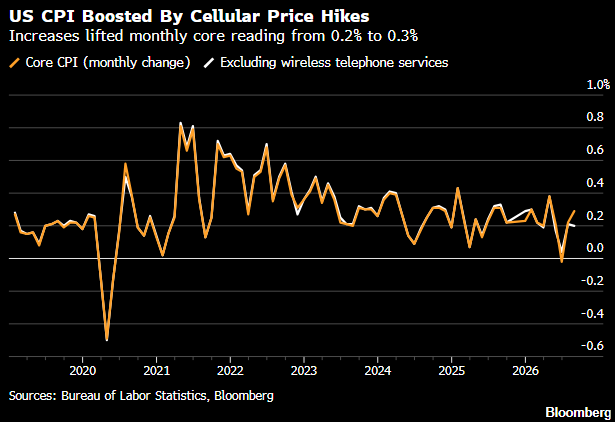
The August Consumer Price Index (CPI) came in above expectations at the core level, providing additional support for a potential Federal Reserve rate hike at its September 16 meeting. Core CPI is a key inflation gauge for both markets and the Fed, and the release was particularly important given that expectations heading into the report were nearly evenly split between a rate hike and a decision to remain on hold.
Core CPI rose 0.3% versus expectations of 0.2%, while headline CPI increased 0.4%. The stronger-than-expected core reading was influenced in part by a 5.9% increase in the Wireless Services Index. Excluding that component, monthly core CPI would have increased approximately 0.19%, essentially in line with expectations. The increase in headline CPI was driven by a 3.9% rise in gasoline prices and the largest monthly increase in housing costs in three months.
Immediately following the CPI report, the Fed funds futures market increased the probability of a September rate hike from approximately 60% to more than 80%. As of September 14, the market was pricing in more than a 90% probability of a rate hike at the September FOMC meeting, along with a cumulative 100 basis points of additional tightening through the end of 2027.

Jobs Rebound in August
On August 19th, the U.S. Treasury announced it would double the size of its longer-dated Treasury buybacks, increasing the minimum operation size from $2 billion to at least $4 billion beginning September 9th. The Treasury said the move is intended to provide greater liquidity support to the long end of the market.
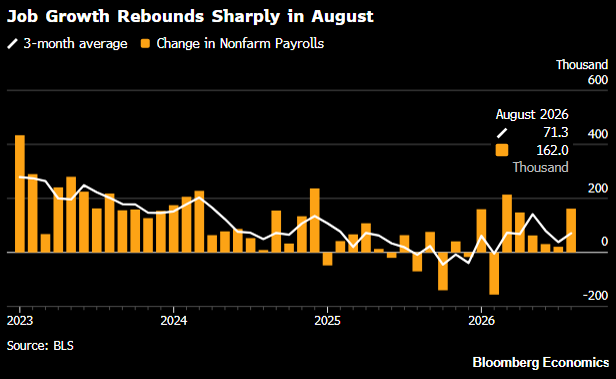
U.S. job growth rebounded sharply in August, with nonfarm payrolls increasing by 162,000—nearly triple expectations. In addition, July’s initially reported decline of 23,000 jobs was revised upward to a gain of 21,000.
The unemployment rate remained unchanged at 4.1% for the second consecutive month, while the labor force participation rate—the percentage of the population working or actively looking for work—increased for the first time since September 2025. An increase in labor force participation typically places upward pressure on the unemployment rate as more people enter the workforce. The fact that unemployment remained unchanged was therefore a positive sign and suggests that the labor market continues to absorb new entrants.
Overall, the report points to a stable labor market operating near full employment, consistent with recent comments from Fed Chair Warsh. When considered alongside the latest inflation report, the data provides the Federal Reserve with additional justification to raise rates at its upcoming meeting.
Global Bond Yields Rise on Renewed Inflation Concerns
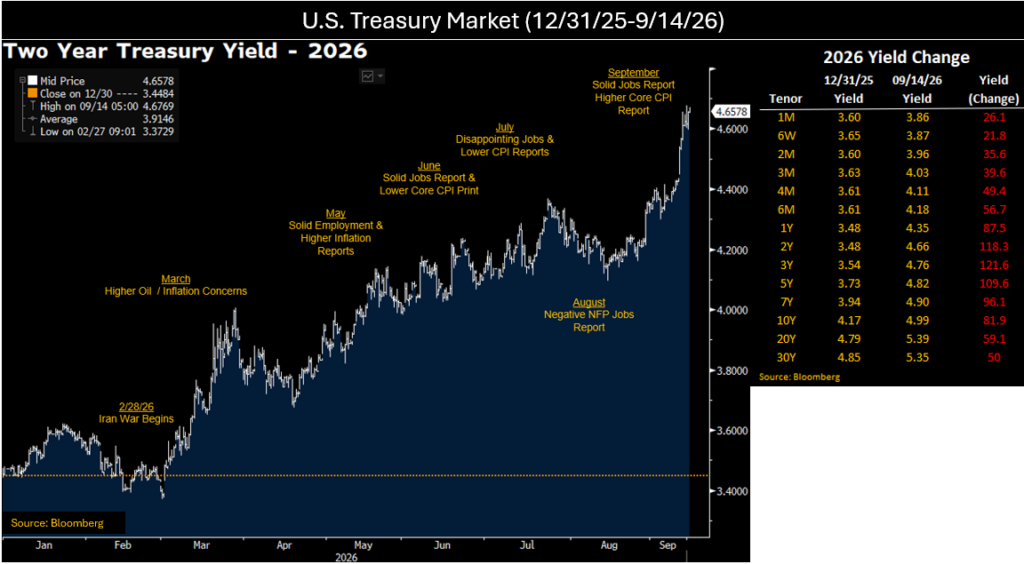
Global bond yields continue to rise amid renewed inflation concerns, as the ongoing conflict in the Middle East offers no clear indication of an end to the war with Iran, which is now approaching seven months. Brent crude has moved back above $100 per barrel while U.S. diesel prices surpassed $6 per gallon for the first time.
In addition to geopolitical developments, renewed tariffs with Canada are contributing to inflation concerns. Combined with resilient economic data and strong AI-related investment, these factors are putting upward pressure on interest rates globally.
In the U.S., the 10-year Treasury yield has been trading around 5% and, on an intraday basis, reached its highest level since 2007. Despite the challenging headlines, risk assets have remained relatively resilient. Through September 14, the S&P 500 and Nasdaq were down modestly for the month, declining 0.80% and 0.66%, respectively, while investment-grade credit spreads were little changed.
Attention now turns to Wednesday’s FOMC meeting, which will include an update to the Fed’s Summary of Economic Projections. The primary focus will be on the Committee’s projections for the federal funds rate over the next several years. In June, the last time the projections were released, the Fed signaled a potential rate hike in 2026, followed by rate cuts in 2027 and 2028.


Please click here for disclosure information: Our research is for personal, non-commercial use only. You may not copy, distribute or modify content contained on this Website without prior written authorization from Capital Advisors Group. By viewing this Website and/or downloading its content, you agree to the Terms of Use & Privacy Policy.