September Month-End Market Update
Fed President Williams: “No need for urgency”
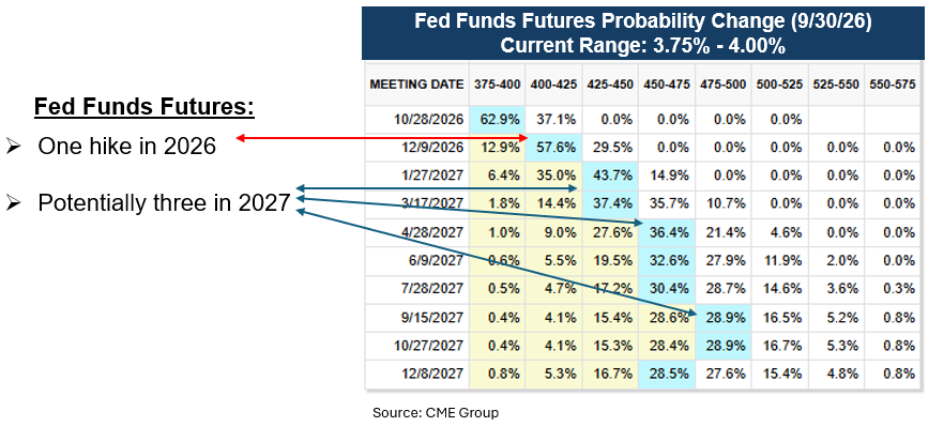
Comments from several FOMC members have remained hawkish, but it was recent remarks from New York Fed President John Williams that prompted a meaningful repricing in rate expectations. In a September 29th speech, Williams said, “If the economy evolves in a manner broadly consistent with my forecast, one further upward adjustment of the federal funds target range may be appropriate late this year to support a timelier return of inflation to target.”
Importantly, Williams’ comments suggest that the Fed may skip a rate hike at its October meeting, leaving December as the more likely timing for another hike if the data continues to support tighter policy. Williams reinforced this view, stating, “With the policy action we took at our September meeting, there is no need for urgency, and we have time to gather more information.”
Following his comments, the Fed funds futures market significantly reduced expectations for an October rate hike. The probability fell from approximately 70% to around 40% as of September 30th, suggesting that investors now see a greater likelihood of the Fed remaining on hold in October and potentially raising rates in December.
PCE Revisions Show Cooler Inflation
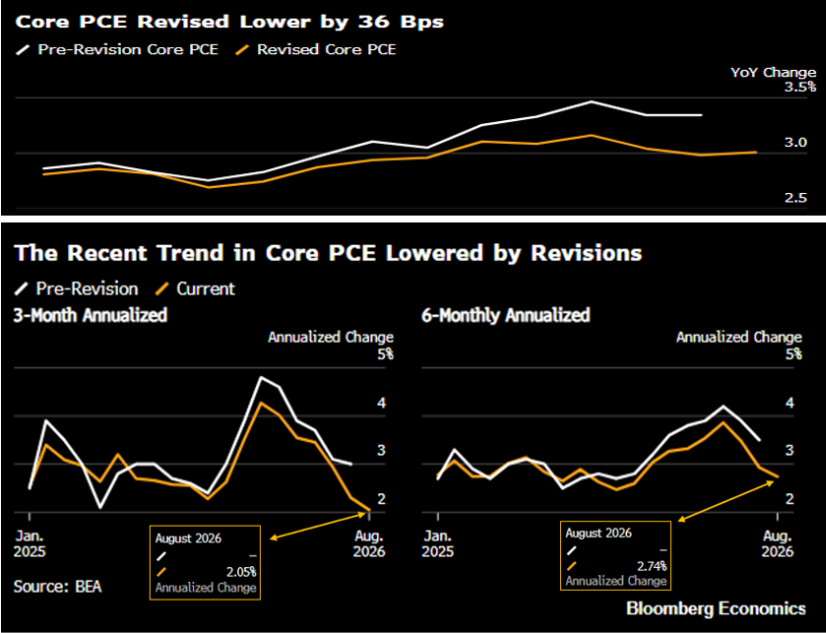
The August reading for the Federal Reserve’s preferred inflation gauge, the Personal Consumption Expenditures (PCE) Price Index, included significant annual revisions from the Bureau of Economic Analysis (BEA). The revisions reduced the year-over-year Core PCE inflation rate by 36 basis points to 3.0%, a larger adjustment than most economists had anticipated.
The revised data also showed a meaningful improvement in the recent inflation trend, with three- and six-month annualized Core PCE readings falling below 3%, to 2.05% and 2.74%, respectively. While inflation remains above the Fed’s 2% target, the revisions indicate cooler underlying inflation than previously estimated. However, the improvement in the shorter-term measures was largely driven by softer June and July inflation readings and does not yet reflect the potential impact of higher input costs from the recent surge in diesel prices, which could put upward pressure on core inflation in the months ahead.
The lower inflation readings should provide some encouragement to Fed officials and may support a more patient approach before implementing additional rate hikes. With recent comments from Fed officials emphasizing that there is no need for urgency, the revised PCE data could give the Fed additional flexibility to wait for more information before tightening policy further.
Treasury Yields Surge in September
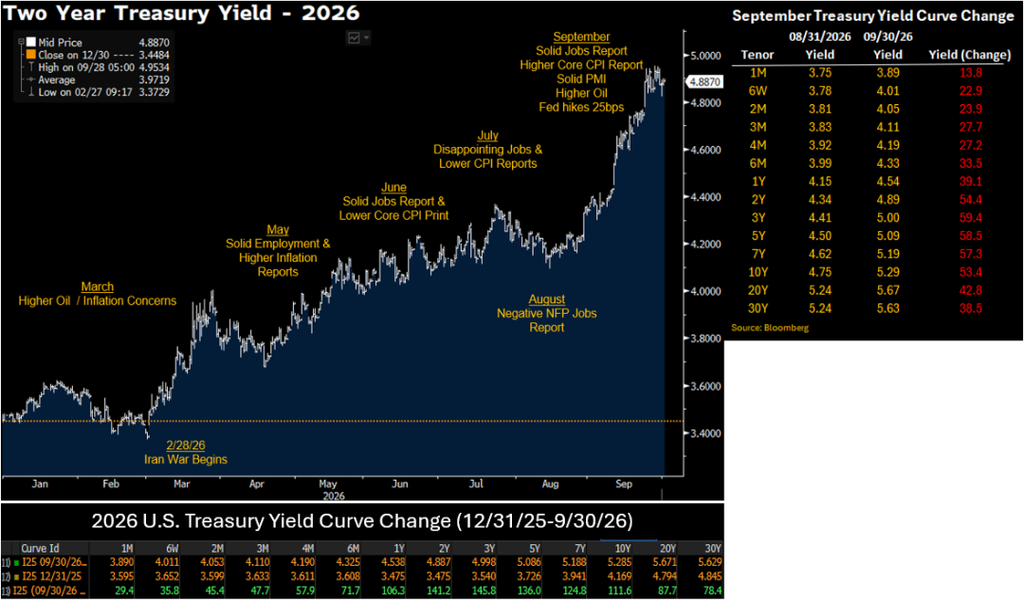
September saw Treasury yields rise sharply across the curve, with a number of factors creating a “perfect storm” for higher rates. Higher oil prices, continued concerns surrounding Iran, resilient retail sales, hawkish Fed commentary, heavy corporate bond issuance, ongoing concerns over fiscal deficits, and a stronger-than-expected PMI release all contributed to the move.
The PMI report was particularly notable, with the stronger-than-expected reading driving a 14-basis-point increase in the 2-year Treasury yield in a single session. PMI data typically does not generate such a significant market reaction, highlighting how sensitive the Treasury market has become to economic data and the potential implications for Fed policy.
Of the 141-basis-point increase in the 2-year Treasury yield year-to-date, 54 basis points—or nearly 40%—occurred over the past four weeks. The move higher was not limited to the 2-year, with yields rising significantly across the curve.
Notable Treasury yield moves in September:
- 30-Year: Reached 5.629%, the highest yield in 24 years.
- 10-Year: Reached 5.285%, the highest yield in 19 years.
- 5-Year: Reached 5.086%, the highest yield in 19 years and the first time above 5% since 2007.
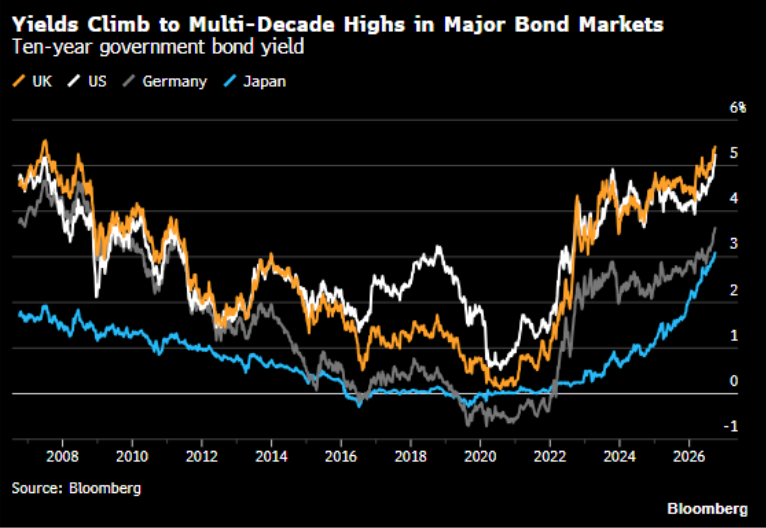
The rise in bond yields has not been limited to the U.S., with government bond yields moving higher across major global markets as inflation concerns, fiscal pressures, and shifting monetary policy expectations weigh on global fixed-income markets. For example, the U.K. 30-year gilt yield reached 6% for the first time in nearly three decades. In addition to the Federal Reserve raising rates for the first time since 2023, both the European Central Bank (ECB) and Bank of Japan (BOJ) also raised rates in September, underscoring that the recent rise in global yields extends well beyond the U.S.
Please click here for disclosure information: Our research is for personal, non-commercial use only. You may not copy, distribute or modify content contained on this Website without prior written authorization from Capital Advisors Group. By viewing this Website and/or downloading its content, you agree to the Terms of Use & Privacy Policy.