October Mid-Month Market Update
September CPI: Price Pressures Persist
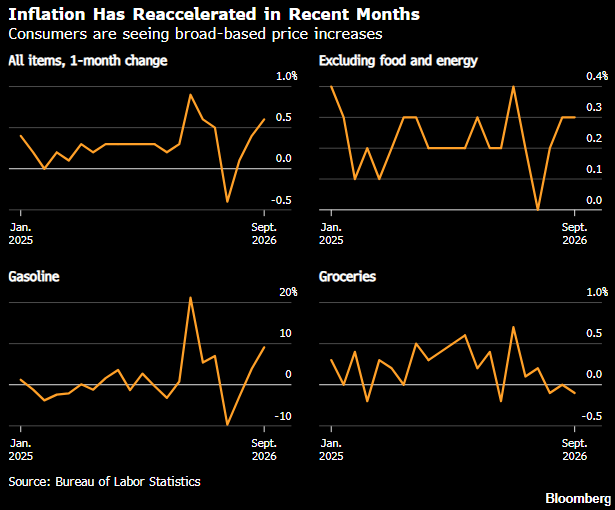
The September CPI report, released October 14th, showed higher prices across most major categories. Headline CPI rose 0.6%, in line with expectations, driven largely by higher energy prices. Core CPI increased 0.3%, matching August’s reading but exceeding expectations of 0.2%. On an unrounded basis, core CPI rose 0.335%, coming close to a 0.4% print. As a result, year-over-year core CPI accelerated to 2.6%, up from 2.4%.
Gasoline prices led the increase in headline inflation, rising 9.1% in September and accounting for more than half of the monthly gain. Overall energy prices increased 5.2%, with both readings representing their second-largest monthly increases since 2022.
More concerning, however, is the potential for higher energy costs to spill over into services prices, putting upward pressure on both headline and core inflation. Meanwhile, higher apparel and used-car prices pushed core goods inflation to its largest monthly increase since January 2025.
Technology-related prices also warrant attention amid the ongoing AI buildout. On a year-over-year basis, computer prices rose 9.7%, while computer software and accessories increased a record 28.4%, adding to concerns about persistent price pressures beyond energy.

Key Fed Officials Signal Patience
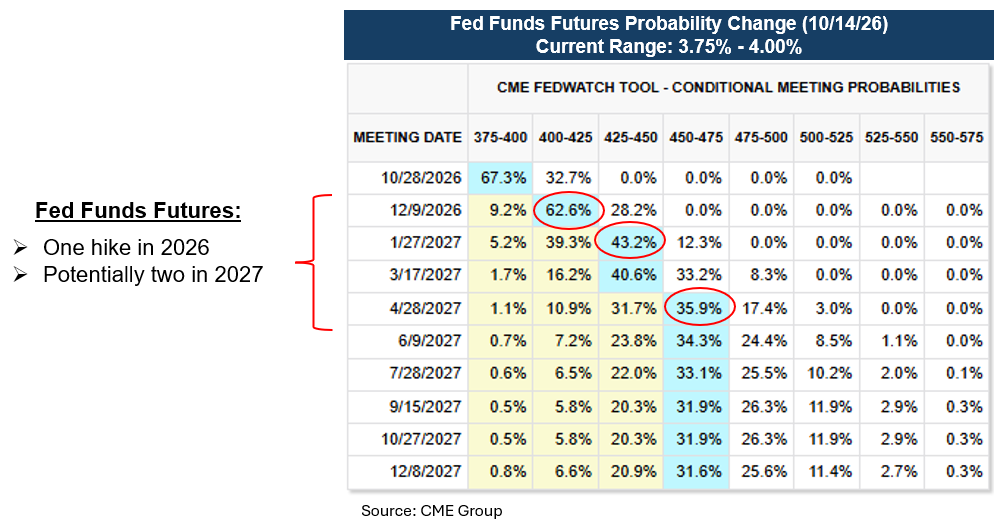
As discussed last month, comments from several FOMC members have remained hawkish. However, recent remarks from key Fed officials have prompted a meaningful repricing of near-term rate expectations. Following the September rate hike, New York Fed President John Williams emphasized that there was “no need for urgency,” signaling that the Fed has time to assess incoming economic data before deciding on its next move. This week he reiterated support for another 25 basis point hike this year but said “I don’t think at this time I have any reason to believe that we would need to do more.” This aligns with the Fed’s latest forecast of being on hold in 2027, which contradicts market expectations that are factoring in two rate hikes in 2027.
Fed Vice Chair Philip Jefferson subsequently struck a similar tone, suggesting officials may need more time before deciding whether to raise rates again. He noted that “my colleagues and I will need to come to our own judgment, which may take more time,” adding that he wants to assess whether underlying inflation trends indicate a sufficiently timely return to the Fed’s 2% target. He also emphasized that additional data could provide greater clarity on both the inflation outlook and the appropriate stance of monetary policy.
Williams and Jefferson are two key members of the Fed’s leadership troika, alongside Fed Chair Kevin Warsh. While Warsh has been reluctant to provide explicit forward guidance, the recent comments from Williams and Jefferson suggest that the Fed is not committed to a predetermined path of consecutive rate hikes.
Even Fed Governor Christopher Waller, who has supported further tightening and sees the potential for two additional rate hikes, emphasized flexibility around the timing. Waller noted that further hikes “do not need to come at consecutive meetings,” but should occur within an acceptable period of time.
The September FOMC minutes reinforced this message, indicating that policymakers would approach each meeting with “an open mind” and that future decisions would depend on incoming information. Taken together, these comments suggest that while additional tightening remains possible, the Fed is not signaling an urgent need to raise rates at every meeting.
Although recent economic data, including a weaker-than-expected September jobs report and downward revisions to the August core PCE reading, has given policymakers some room to be patient, the hotter-than-expected September CPI report adds pressure on the FOMC to address persistent inflation concerns.
As of October 14th, 2026, Fed Funds futures reflect this shift in expectations, pricing in the Fed to remain on hold at its October meeting while assigning a 62% probability to a 25-basis-point rate hike at the December 9th FOMC meeting (see chart below). The market’s current outlook suggests that policymakers may prefer to gather additional data before deciding whether further tightening is warranted.
October Markets: Yields Lower, Equities & Credit Stable
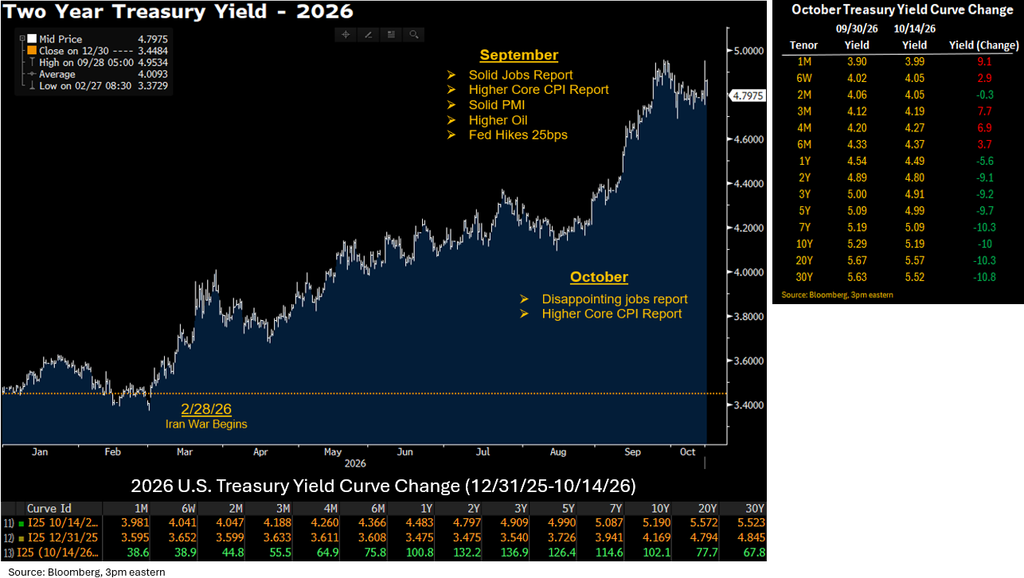
Treasury yields have declined so far in October following September’s multi-decade highs, with yields on 1-year to 30-year maturities down approximately 5–10 basis points (see chart below). Despite concerns that the Treasury’s October 3-year, 10-year, and 30-year auctions might require higher yields to attract buyers, all three auctions drew solid demand and were comfortably absorbed by the market.
Risk assets have also performed well in October, with both the S&P 500 and Nasdaq reaching new all-time highs, while credit markets have remained stable. Investment-grade spreads have held firm, with spreads in the 1-year and intermediate sectors tightening modestly, while the 1–3-year sector has been little changed. High-yield credit has also held up well, with the Bloomberg High Yield Index remaining little changed for the month.
Overall, the combination of declining Treasury yields, resilient equity markets, and stable credit spreads points to a constructive market environment so far in October, despite ongoing concerns around inflation, fiscal deficits, and the potential path of Fed policy.
Please click here for disclosure information: Our research is for personal, non-commercial use only. You may not copy, distribute or modify content contained on this Website without prior written authorization from Capital Advisors Group. By viewing this Website and/or downloading its content, you agree to the Terms of Use & Privacy Policy.