October Month-End Market Update
AI Concerns Reshape Rate Expectations
The September rise in Treasury yields pulled back in October. A flight-to-quality bid emerged amid growing concerns about the sustainability of AI-related capital expenditures and a repricing of expectations for future Fed rate increases. This occurred despite higher-than-expected inflation readings and rising oil prices, suggesting that concerns about the potential economic impact of a slowdown in AI investment began to outweigh near-term inflation concerns. The Nasdaq declined 5.28%, marking its worst monthly return since March 2025. In contrast, the Dow gained 1.76%, while the S&P 500 edged lower by 0.87%, highlighting the greater weakness in technology and AI-related stocks.
Investor concerns surrounding the AI sector have broadened, ranging from increasing competition from China to the rising cost of financing the substantial capital expenditures required to support continued growth. A pullback in AI-related spending could have broader economic implications, potentially weighing on GDP growth, corporate investment, and business confidence. These concerns have contributed to increased demand for the relative safety of U.S. Treasuries, helping push yields lower even as inflation readings remained elevated.
Fed Rate Expectations Undergo Another Shift
The chart below highlights not only the decline in Treasury yields during October, but also the considerable volatility in market expectations for Fed policy throughout 2026. Coming into the year, the consensus was for one to two rate cuts in 2026. Following the outbreak of war with Iran, rising energy prices and renewed inflation concerns caused expectations to shift from rate cuts to a prolonged pause, and eventually to rate increases.
Following Kevin Warsh’s hawkish statements at Jackson Hole and the hotter-than-expected inflation readings in early September, markets began pricing in the eventual hike in September, plus additional increases in 2027. However, more recent comments from several key Fed officials emphasizing patience and the need for more time to assess incoming economic data helped temper those expectations, contributing to the October rally in Treasuries.
At the start of October, fed funds futures were pricing in the potential for as many as three rate hikes in 2027. By month-end, the 2027 expectation had declined to just one additional hike. Expectations for the December FOMC meeting also moderated, with the probability of a rate increase declining from approximately 82% at the beginning of the month to around 72% by month-end. Although a December hike remains the prevailing market expectation, the declining probability highlights growing uncertainty surrounding the Fed’s next policy move.

Q3 GDP: Growth Remains Strong
Third-quarter GDP came in stronger than expected, rising 3.6%, matching the consensus forecast. Growth was led by consumer spending, which increased 3.8%, matching the pace of the second quarter gain which was the strongest reading in seven quarters, despite elevated inflation.
A measure of underlying domestic demand was even stronger. Private Domestic Final Purchases (PDFP), sometimes referred to as “core GDP,” rose 4.9%, its strongest reading since 2021. PDFP excludes government spending, net exports, and changes in private inventories, providing a clearer picture of demand from domestic consumers and businesses.
Business investment also remained robust, reflecting the continued impact of AI-related spending. Nonresidential fixed investment increased 12.7%, its strongest gain since 2020, led by a 20.9% surge in business equipment investment. The strength in this category highlights how investment in technology and AI infrastructure continues to support economic growth.

Higher PCE Keeps Fed Hikes in Play
The Fed’s preferred inflation gauge, the Personal Consumption Expenditures (PCE) Price Index, showed renewed price pressures in September. Headline PCE increased 0.5% for the month, while Core PCE rose 0.3%, bringing year-over-year inflation to 3.6% and 3.1%, respectively.
The annualized trends are also concerning. The one-month annualized rate accelerated to 3.9%, up from 3.2% previously, while both the three- and six-month annualized rates stood at 2.9%. These readings suggest that inflation remains elevated and continues to complicate the Fed’s path toward its 2% target.
There was, however, some encouraging news beneath the headline numbers. The share of PCE components experiencing price increases above 3%, a metric Fed Chair Warsh has highlighted, declined from 53% to 49%, suggesting that the breadth of inflationary pressures may be moderating.
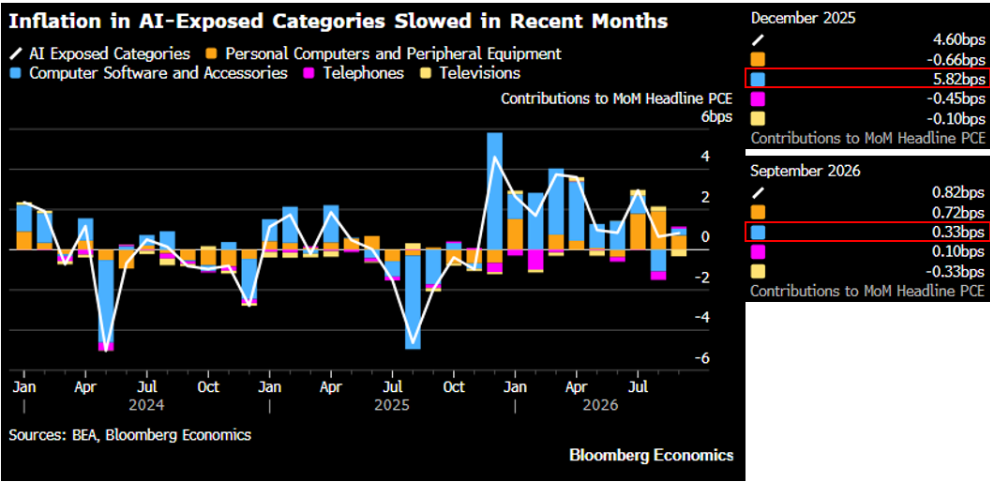
As illustrated in the chart below, AI-related investment continues to influence pricing trends. However, some of the price pressures that emerged late last year and persisted through the first half of 2026 have begun to ease, particularly in the computer software and accessories category. This moderation is a positive development, although broader inflation readings remain elevated.

Please click here for disclosure information: Our research is for personal, non-commercial use only. You may not copy, distribute or modify content contained on this Website without prior written authorization from Capital Advisors Group. By viewing this Website and/or downloading its content, you agree to the Terms of Use & Privacy Policy.