July Mid-Month Market Update
Economic Data Pushes Out Potential Rate Hike
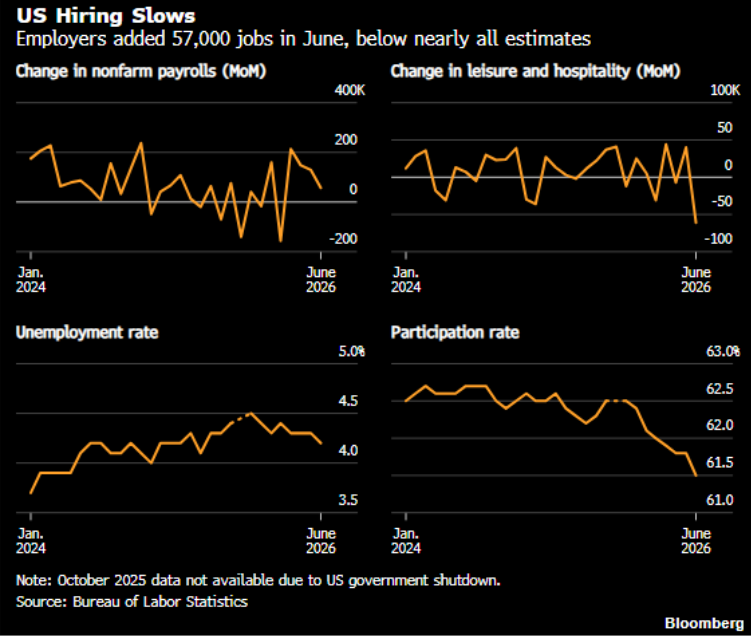
Recent labor market and inflation data prompted the fed funds futures market to fully price in a rate hike by December, pushed back from expectations for a September hike earlier this month. Despite the shift, the broader consensus among economists continues to be that the FOMC is more likely to remain on hold throughout 2026 rather than raise interest rates.
- Labor Market: The June employment report pointed to a softer labor market than expected. Nonfarm payrolls increased by just 57,000, well below the consensus forecast of 113,000, while the prior two months were revised lower by a combined 74,000 jobs. Although the unemployment rate declined to 4.2% (4.189% unrounded versus 4.296% previously), the improvement reflected weaker labor force participation rather than stronger hiring. Approximately 700,000 workers exited the labor force, pushing the labor force participation rate down to 61.5%, its lowest level in five years. While demographic trends, including an aging population and slower immigration, have contributed to the decline in labor force participation over the past year, June’s report also showed a notable drop in participation among prime-age workers (25–54), a group typically viewed as the core of the labor force.
- Inflation: The June Consumer Price Index (CPI) also came in below expectations. Headline CPI declined 0.4% during the month, compared with expectations for a 0.1% decline, marking the first monthly decrease since May 2020 and the largest drop since April 2020, driven primarily by the sharpest monthly decline in gasoline prices since 2022. Core CPI, which excludes food and energy, was unchanged versus expectations for a 0.2% increase. The softer-than-expected core reading is an encouraging development for the Federal Reserve, although some of the weakness appears to reflect one-time or volatile components, including a 2.0% decline in motor vehicle insurance and a 2.3% decline in lodging away from home, despite elevated travel demand associated with the World Cup.
Looking ahead, the inflation outlook remains uncertain. Oil prices have rebounded roughly 15% for both WTI and Brent crude as renewed attacks on ships in the Strait of Hormuz have slowed shipping traffic, along with the reimposition of U.S. sanctions on Iranian vessels. If sustained, higher energy prices are likely to place renewed upward pressure on headline inflation in the months ahead, reinforcing the Federal Reserve’s cautious, data-dependent approach to monetary policy.

Record Pace for U.S. Convertible Bond Issuance
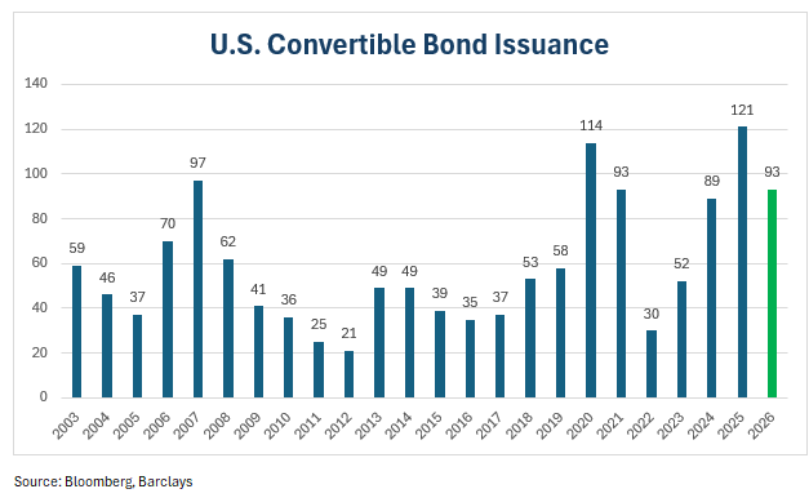
Convertible bond issuance has reached a record pace in 2026, with more than $93 billion priced through the second week of July—putting the market on track to surpass 2025’s record issuance of $121 billion (see chart below). Technology and Communications companies account for 64% of issuance, while Health Care represents 9% (see chart below). Similar to the investment-grade market, AI-driven capital spending continues to be the primary catalyst, as strong equity valuations make convertible financing an increasingly attractive and cost-effective source of capital.

Markets Little Changed in July
- Markets have been relatively stable through the first half of July, with modest moves across most major asset classes as investors continue to balance easing inflation pressures against an uncertain monetary policy outlook.
- Treasuries: Treasury yields have been mixed. Front-end yields out to six weeks, along with maturities from five to thirty years, have moved modestly higher, while yields from two months through three years have declined as markets continue to push out the timing of any potential Fed rate hikes (see first chart below).
- Equities: Equity markets have posted modest gains during the month. Through mid-July, the S&P 500 is up 1.0%, while the Dow Jones Industrial Average and Nasdaq have gained 0.7% and 0.2%, respectively.
- Credit: Investment-grade credit spreads have remained remarkably stable despite another heavy month of new issuance. Last week, Amazon’s $25 billion bond offering helped push weekly issuance above $50 billion for the second time in three weeks. Through Wednesday, July 15, this week’s new issuance had already exceeded $40 billion, underscoring the market’s continued ability to absorb elevated supply.
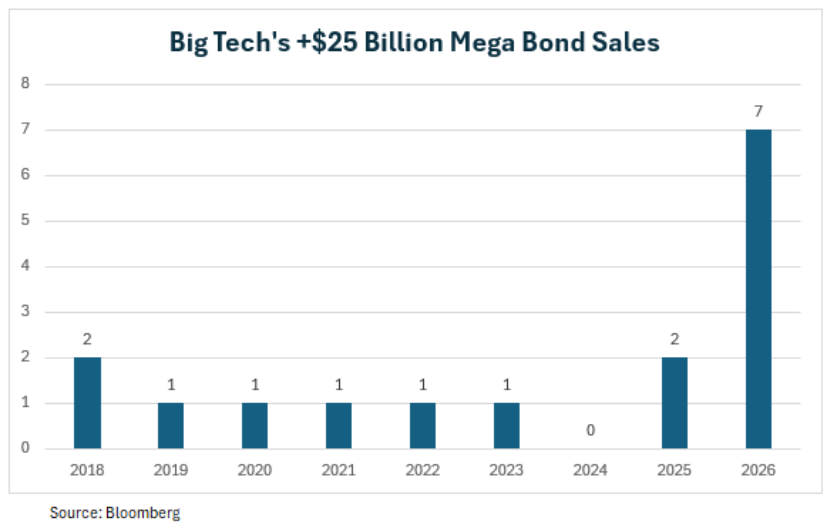
- Technology hyperscalers continue to dominate the primary market. Year-to-date, there have been seven investment-grade bond offerings of $25 billion or more, compared with just two during all of 2025 (see second chart below). The sustained pace of issuance highlights both the significant capital needs associated with AI-related investment and the continued depth of investor demand for high-quality corporate credit.

Please click here for disclosure information: Our research is for personal, non-commercial use only. You may not copy, distribute or modify content contained on this Website without prior written authorization from Capital Advisors Group. By viewing this Website and/or downloading its content, you agree to the Terms of Use & Privacy Policy.