
Strategic Divestitures: How Consumer Brands Are Shrinking to Grow
Key Takeaways:
- Consumer goods companies are divesting low-growth business units to focus on their more profitable core sectors.
- CEO turnover is rising in the consumer goods industry as companies aim for strategic growth and restructuring.
- Economic challenges, including slowing consumer demand and persistent cost inflation are driving portfolio restructuring and business divestitures across the sector.
Over the past year, several major consumer goods companies have announced plans to divest underperforming business segments and refocus on streamlined portfolios with stronger growth potential. These announcements follow marked top-line deceleration from their post-pandemic heydays, where revenues benefited from large price increases at the expense of margin compression. While profitability generally improved as inflation eased, companies now face a more challenging environment, characterized by cautious consumer spending, slower economic growth, and ongoing cost inflation – especially in key commodities like coffee and cocoa, along with rising tariff expenses. As a result, many companies are performing a delicate balancing act to boost sales and profitability while managing persistent inflationary pressures and navigating heightened market uncertainty.
Exhibit 1: Personal consumption growth continues to moderate
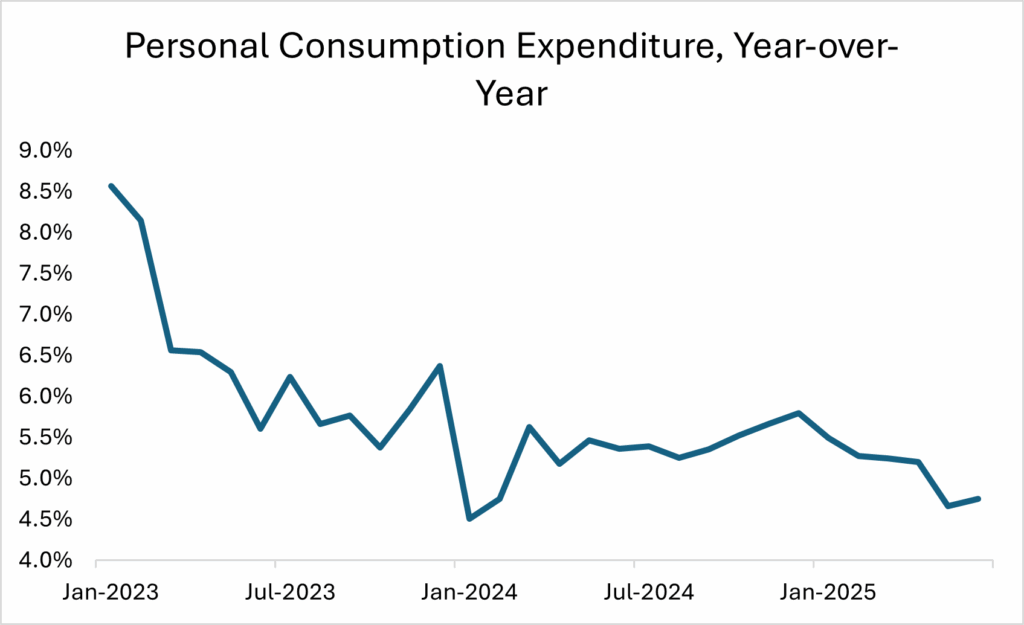
Source: Bureau of Economic Analysis
Exhibit 2: Coffee and cocoa prices have been recent sources of cost inflation for some companies

Source: Refinitiv
Divesting to Grow: The Rise of Portfolio Pruning in Consumer Goods
In response to a more difficult operating environment, many companies are adopting aggressive strategies to boost top-line growth and bottom-line profitability. Rather than acquiring higher-growth businesses, the sector has instead trended toward divestments of lower-growth businesses.
Europe’s two largest consumer goods companies, Unilever and Nestlé, have each announced plans to spin off their lowest-margin businesses. Unilever is on track to divest its ice cream business by the end of 2025, citing key operational differences from its core consumer brands. Similarly, Nestlé plans to transition its waters and premium beverages segment into a global standalone business. Additionally, Reckitt Benckiser announced plans to divest a 70% stake in its essential home business, aiming to refocus on its “core portfolio of high-growth, high-margin Powerbrands.”[1] These strategic divestitures are expected to enhance greater profitability and growth prospects, even as they modestly reduce portfolio diversification while preserving core business operations.
Exhibits 3 and 4: Underlying Trading Operating Profit (UTOP) Margin by Business Segment, 2024


Sources: Company filings
In the U.S., Kraft-Heinz is reportedly considering a much bigger restructuring. According to the Wall Street Journal, the company may divest its grocery and sauces divisions, potentially unwinding the $45 billion merger between Kraft and Heinz.[2] Since the two entities merged in 2015, the company has contended with shifting consumer preferences toward healthier options, which has primarily impacted their food brands. As a result, a standalone condiments business may have greater growth potential. While investors may expect higher equity valuations from such a split, it is too early to determine the credit impact due to limited details available.
C-Suite Shakeups: Leadership Changes Accelerate in Consumer Companies
Coinciding with the business divestitures, C-suite turnover has risen across the consumer goods sector, with underperforming executives increasingly being replaced. Nestlé and Unilever exemplify this trend. In August 2024, Nestlé’s CEO Mark Schneider resigned amid slowing growth and operational challenges in certain business segments. Similarly, Unilever’s CEO transition in February 2025 indicated a push to accelerate the company’s “Growth Action Plan.”[3]
Most recently, Diageo’s CEO resigned after two years amid turbulence in the spirits sector compounded by tariffs. Starbucks also experienced a high-profile leadership change in 2024, hiring Brian Niccol from Chipotle with one of the largest executive compensation packages in corporate America, according to Bloomberg.[4] This trend of CEO transitions mirrors the broader trend of business restructurings across the consumer goods sector, highlighting how many companies are aiming to re-invigorate their growth strategies and navigate a more volatile market environment.
Conclusion
Amid a challenging backdrop, consumer product manufacturers are reassessing their market positioning. Slowing personal consumption, driven by tighter economic conditions has weighed on organic growth, while the previous bout of inflation has left consumers sensitive to further price shocks. In response, many companies are re-evaluating their brand portfolios, aiming to divest lower-growth segments. This transition has also prompted boards to re-consider executive leadership, questioning whether current CEOs are equipped for such changes, or if a new executive should lead the way.
While the inherent stability of consumer staples provides a cushion to credit profiles given predictable cash flows, a growing number of companies are choosing to shrink in order to grow.
[1] https://www.reckitt.com/media-landing/press-releases/2025/reckitt-agrees-to-divest-essential-home/
[2] https://www.wsj.com/business/deals/kraft-heinz-split-3e75294e?gaa_at=eafs&gaa_n=ASWzDAjTRM1lp0PMTsPHAYMAkv0hAmcO3YQ0yTF2o-9syQP2GwJ44UH_viBLgEDSSk0%3D&gaa_ts=6887bca0&gaa_sig=_PqKpc02c3YgJy1lJ-srmgjcxp4KSQdK86wi1udHycQpyknqv2ufIP8IG96sPop5TcTgxNpVftbI1r6MYMYh7A%3D%3D
[3] https://www.unilever.com/news/press-and-media/press-releases/2025/unilever-board-update-25-02-25/
[4] https://www.bloomberg.com/news/articles/2025-01-24/starbucks-ceo-made-96-million-in-first-four-months-on-the-job
Please click here for disclosure information: Our research is for personal, non-commercial use only. You may not copy, distribute or modify content contained on this Website without prior written authorization from Capital Advisors Group. By viewing this Website and/or downloading its content, you agree to the Terms of Use & Privacy Policy.