February Month-End Market Update
Fed Tone Suggests Patience on Rate Cuts
We have seen a noticeable shift in the Federal Reserve’s tone over the past several weeks, including comments from several of its more dovish members that reinforced expectations that the FOMC will remain on pause for the time being.
- FOMC Minutes (January Meeting): The January minutes included a notably hawkish passage referencing the possibility of higher rates: “Several participants indicated that they would have supported a two-sided description of the Committee’s future interest rate decisions, reflecting the possibility that upward adjustments to the target range for the federal funds rate could be appropriate if inflation remains at above-target levels.” The inclusion of potential “upward adjustments” underscores the Committee’s continued sensitivity to inflation risks.
- Governor Miran: The most dovish member since joining the Fed in September — and a dissenter at every meeting in favor of additional rate cuts — Governor Miran recently signaled a moderation in his stance. He noted that the economy has evolved somewhat differently than he expected and suggested that, if forced to submit his rate projection today, he would likely move his policy “dot” back toward its September level, implying fewer or later cuts than previously anticipated.
- Governor Christopher Waller: Another recent dissenter, Christopher Waller indicated he could support holding rates steady if upcoming labor market data remain strong. He stated that if February employment data confirmed resilient job creation and low unemployment — thereby reducing downside labor market risks — it “may be appropriate to hold the FOMC’s policy rate at current levels” while monitoring inflation progress.
- Boston Fed President Susan Collins: Susan Collins echoed this sentiment, noting that “it’s quite likely that it will be appropriate to hold the current range for some time.”
Importantly, the shift in tone from policymakers who had previously leaned dovish has delayed market expectations for additional rate cuts. Higher energy prices resulting from the war in Iran are amplifying existing inflation concerns and have helped push forecasts for the next cut from June to September.

Recent Data Supports Continued Fed Pause
Economic data released over the past several weeks reinforce the case for the Fed to remain on hold in the near term, as inflation pressures persist despite some moderation in growth.
- January Producer Price Index (PPI): PPI surprised to the upside, with headline PPI rising 0.5% (the highest monthly increase since last September) and Core PPI increasing 0.8% (the strongest since July). This report carries added significance because PPI components feed directly into the Fed’s preferred inflation measure, the Personal Consumption Expenditures (PCE) Index. Current expectations for January Core PCE are around +0.5% — a level that would likely raise concern within the FOMC if realized.
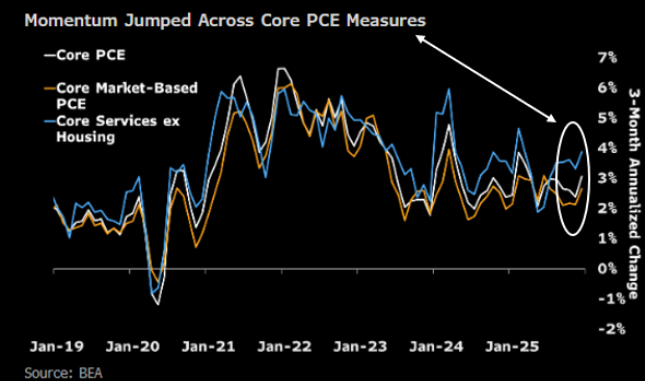
- December PCE: The prior month’s PCE data also came in firmer than expected. Both headline and core rose 0.4% month-over-month, marking the highest monthly core reading since February 2025. On a year-over-year basis, inflation moved back up to 3.0%. Shorter-term annualized trends have also accelerated, with the 1-, 3-, and 6-month annualized rates rising to 4.3% (vs. 2.0% prior), 3.1% (vs. 2.4% prior), and 2.9% (vs. 2.7% prior), respectively (see chart below). These momentum measures suggest inflation progress has stalled somewhat in recent months.
- Q4 GDP: Fourth-quarter GDP came in at +1.4%, below expectations of +2.8%. The primary drag on the headline figure was the government shutdown, as federal spending declined at the fastest pace since 1972, subtracting approximately 1.5 percentage points from growth. As is typical with shutdown-related distortions, this weakness is likely to reverse in the subsequent quarter. Importantly, personal consumption rose 2.4%, in line with expectations, though down from a robust +3.5% in Q3. For full-year 2025, GDP growth registered +2.2%, essentially in line with the 25-year average of +2.22%.
Taken together, sticky inflation readings and resilient consumer activity provide the Fed with little urgency to resume cutting rates, supporting a continued pause in the near term.
Market Review: Volatility, Rates, and Rising Geopolitical Risk
Despite the equity volatility experienced so far this year, front-end credit spreads have remained resilient. Both the Bloomberg Short-Term Credit Index and the Bloomberg 1–3 Year Credit Index are tighter year-to-date, reflecting continued demand for high-quality, shorter-duration corporate exposure.
Within equities, performance dispersion has been notable. The Nasdaq has borne the brunt of the weakness, largely due to its heavier concentration in technology and software names. In contrast, the Dow Jones Industrial Average managed to post a modest gain of 0.31% in February, while the S&P 500 was down just 0.76% in February.
Overall, the relative stability in short-duration credit markets suggests that, despite equity volatility, broader financial conditions remain orderly.

Treasury yields were mixed over the period. Maturities out to one year were little changed, while yields from 2 years through 30 years declined by 14 to 31 basis points, largely driven by a flight-to-quality bid amid broader market volatility.
The 2-year Treasury yield fell 15 basis points in February. While longer maturities benefited from risk-off flows, movements at the front end were shaped more directly by shifting Fed expectations. Notably, hawkish commentary from Fed officials and the repricing of the first anticipated rate cut further into the year contributed to volatility in short-term yields before they ultimately moved lower.
So far in the early days of March, Treasury yields have moved higher as the Iran war is rekindling inflation concerns.
US Treasury Curve – February Yield Change

Source: Bloomberg
Heading into February month-end, escalating concerns over a potential attack on Iran sparked a broad risk-off move across markets. U.S. Treasuries rallied, gold advanced 7.9% for the month, and oil prices moved higher, with Brent and WTI crude rising 2.5% and 2.8% for the month of February (1/30/26-2/27/26).
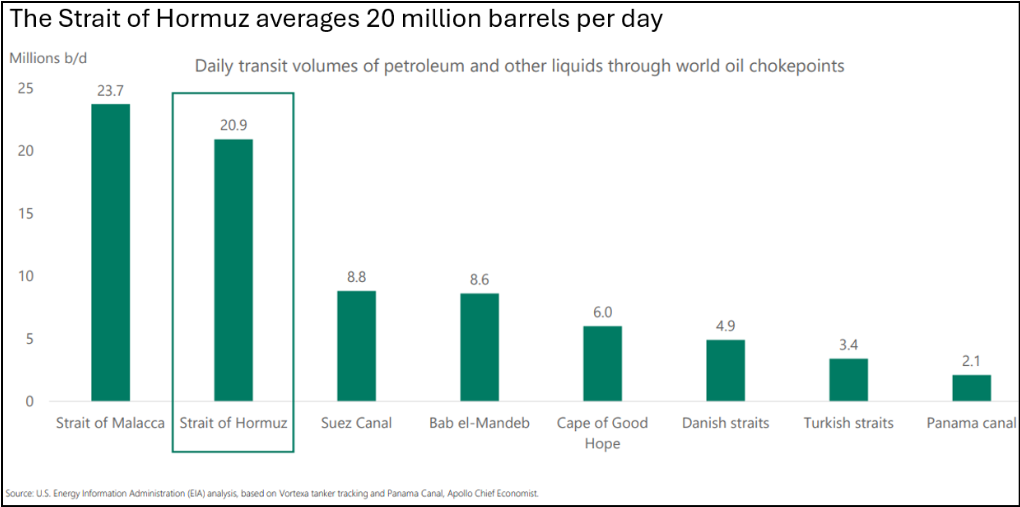
Over the weekend, crude prices extended their gains amid heightened uncertainty around how the Iranian conflict could affect shipping flows through the Strait of Hormuz — a critical chokepoint for global energy supply. These concerns carried into Monday, March 2nd, with WTI climbing to over $71, up more than 9% from Thursday’s close to its highest closing level since 2024 (see chart below).
The price action underscores how quickly geopolitical risk can be transmitted into energy markets, particularly when potential supply disruptions are involved.

Please click here for disclosure information: Our research is for personal, non-commercial use only. You may not copy, distribute or modify content contained on this Website without prior written authorization from Capital Advisors Group. By viewing this Website and/or downloading its content, you agree to the Terms of Use & Privacy Policy.