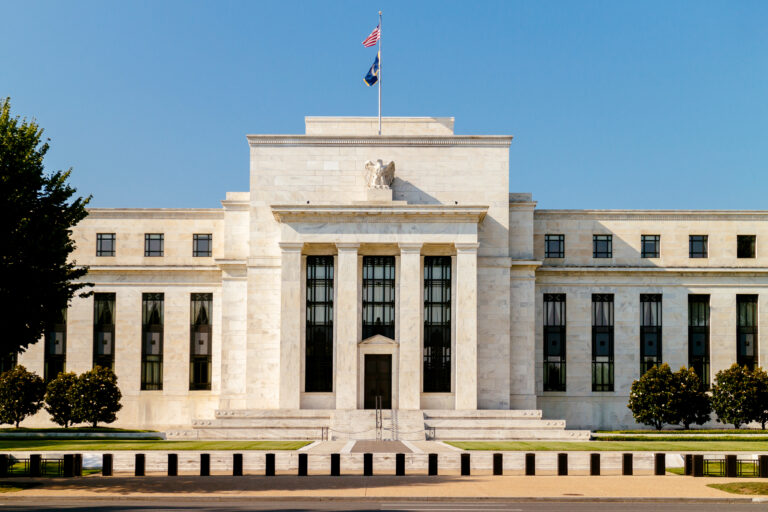
Trade Wars Reloaded: How Tariffs Impact Inflation and the Fed’s Balancing Act
Key Takeaways:
- Historic U.S. trade shock: The past five months mark a historic trade shock for the U.S. economy, with importers currently facing a 9% tariff rate – half of the projected 18%.
- Inflation and interest rate risks: Markets may be underappreciating the upside risks tariffs pose to consumer prices, inflation, and interest rates.
- Federal Reserve challenges: Elevated tariffs could challenge the Fed’s efforts to “normalize” monetary policy. In the event of stagflation, it’s unclear whether the Fed would prioritize price stability or labor market support.
Tariffs Fade, But Risks Remain
With trade war tensions easing, tariff uncertainty is beginning to fade. The U.S. economy has so far avoided recession, despite a slowdown in growth, while inflation remains close to the Federal Reserve’s 2% target. Stock markets are reaching new all-time highs and bond yields continue to decline, implying economic stability. However, evolving tariff policies still pose risks – increased costs for consumers and shifting market conditions for investors.
Trade Talks Fading? The Risks That Could Shock the Economy
Notably, most recent trade agreements have been informal handshake deals, leaving precise terms subject to change. Negotiations remain fluid, and India’s tariffs are set to climb to 50% later this month. While the stop-and-start pauses of earlier trade talks are mostly behind us, changing tariff policies continue to influence consumer prices, business costs, and investor confidence in the markets.
| Region/Country | Announced Rate (8/19/25) | Effective Rate (8/1/25) | Goods Import Share |
| EU | 15% | 16% | 18% |
| Mexico | 25% | 8% | 16% |
| China | 30% (reciprocal tariffs on 90-day hold) | 40% | 13% |
| Canada | 35% | 6% | 13% |
| Japan | 15% | 15% | 5% |
| Vietnam | 20% | 18% | 4% |
| South Korea | 15% | 13% | 4% |
| Taiwan | 20% | 9% | 4% |
| India | 25% (set to rise to 50% on 8/27/25) | 19% | 3% |
Sources: U.S. Census Bureau, Bureau of Economic Analysis, J.P. Morgan Research, New York Times
The worst-case scenarios from global trade tensions have largely been avoided. In particular, the U.S.-China trade war, which threatened tariff rates as high as 145%, has simmered down. However, the effective tariff rate remains roughly five times higher than at the end of 2024. The last time a trade shock of anything close to this magnitude occurred was 100 years ago, with the introduction of the Smoot Hawley tariffs at the onset of the Great Depression.

Source: J.P. Morgan Research
This trade shock may arguably be more impactful than the Smoot-Hawley tariffs, as the U.S. is more reliant on global trade today than in the 1930s. According to the Yale Budget Lab, the drag on GDP is estimated at approximately 0.5% in both 2025 and 2026, highlighting the ongoing economic implications of increased tariffs.
Why the U.S. Avoids a Recession Despite Trade Shocks
So how is the U.S. economy still on solid footing despite elevated tariffs and trade shocks? The most straightforward explanation is that the U.S. remains a relatively “closed” economy. Trade equates to only 25% of U.S. annual economic output, compared to 58% among OECD peers, according to the World Bank. This lower reliance on trade reduces the economy’s sensitivity to global trade shocks. Based on the Yale Budget Lab estimate, the 0.5% drag on GDP from tariffs alone is not enough to trigger a recession, but it does leave the economy more vulnerable to other headwinds like weaker consumer spending or slower business investment.
How Trade Disruptions May Impact Consumer Prices
The inflation story remains more complex. In theory, a trade shock of this magnitude could cause a one-time increase in the price level, producing a short-lived inflation spike that eventually fades. So far, this effect hasn’t materialized: CPI inflation stands at 2.7% year-over-year.
One contributing factor is tariff “front-running.” Importers rushed shipments in Q4 2024 and Q1 2025 to avoid higher tariffs, stockpiling “tariff free” inventory. This led to a temporary surge in imports, which then fell below trend in April following the tariff announcements.

Source: U.S. Census Bureau
Timing is another key factor. As Chris Giles of the Financial Times notes, tariffs apply only to goods at the port of origin, so shipments already in transit are unaffected. Additionally, importers can defer tariff payments for up to six weeks. As a result, the current tariff payments collected equate to only 9% of total import value, only half the effective tariff rate.

Source: Peterson Institute of International Economics
Many firms have chosen to absorb tariff costs rather than pass them on. A recent Goldman Sachs study estimates that roughly two-thirds of the tariff burden is being absorbed by domestic firms, with the remaining third split between foreign firms and consumers. This may reflect cautious behavior during periods of high tariff uncertainty, a phenomenon that is compatible with recent research. Additionally, a rebound in corporate revenues has given firms with additional capacity to absorb these costs.
However, these effects are all likely temporary phenomena. As inventories are depleted and deferral options expire, tariff collections are expected to rise toward the effective rate. A recent spike in wholesale prices suggests this process may already be taking place. In competitive industries with constrained profit margins, much of the tariff burden may eventually be passed on to consumers through higher prices. While the magnitude of tariff inflation has remained subdued, the direction of consumer prices remains upward.
The Fed’s Position Amid Trade Shocks: Uncertain Priorities
Tariffs and trade shocks may complicate the Fed’s plans to “normalize” monetary policy through rate cuts. In theory, as Governor Christopher Waller recently noted, the Fed can “look-through” a temporary spike in inflation. In reality, that may be easier said than done.
The 2021-2022 inflation period is illustrative in this regard. Like the current cycle, that bout of inflation was driven largely by supply-side factors: COVID-era supply bottlenecks caused widespread shortages of goods such as semiconductors. At the time, the Fed reasoned that the rise in inflation was “transitory” and could be looked through. While the shock was short-lived relative to historical standards, the rise in inflation was much larger than expected. The rise also drew significant public ire, forcing Chair Powell to publicly reestablish the Fed’s commitment to its 2% inflation target.
This period illustrates both the difficulty of economic forecasting and the public’s limited tolerance for higher prices. If tariffs trigger stagflation, where inflation rises alongside unemployment, the Fed could face tough tradeoffs. The magnitude of these effects matters: for example, how much the labor market has deteriorated vis-à-vis to how far away inflation is from the Fed’s target. All else equal, it remains uncertain whether the Fed would prioritize price stability or the labor market.
Conclusion
For investors, the key takeaway is that full impact of tariffs has not yet been materialized. Tariff collections are expected to rise in the coming months as firms deplete their pre-tariff inventories and new agreements take effect, likely pushing more costs onto consumers.
For the Fed, the challenge is whether it can credibly “look-through” tariff-driven inflation. Given the scars from the recent inflation cycle, Fed leadership may be less willing to risk its credibility this time. At a minimum, elevated tariffs represent a significant obstacle to lowering interest rates toward a “normalized” level.
Please click here for disclosure information: Our research is for personal, non-commercial use only. You may not copy, distribute or modify content contained on this Website without prior written authorization from Capital Advisors Group. By viewing this Website and/or downloading its content, you agree to the Terms of Use & Privacy Policy.